

Let’s say you come across someone you might want to hire. There are promising signs, but you don’t have that much information on them.
What are the next steps?
Of course, if you’re already running a hiring round, then you’ll want to ask them to drop an application into that. You’ve already designed a round with processes which sit precisely on the frontier somewhere in the N-dimensional tradeoff space of the relevant desiderata, right?1
But if you’re not running a hiring round for a pre-defined role, you’ll want to start off with something easier than fully assessing them for every plausible role.
I’ll frame the situation to the candidate something like this:
I don’t currently have any open hiring rounds that would clearly be a good fit for your profile, but it does seem plausible that we might be able to find a role that is a great fit.
Obviously, the bar for me running an off-cycle hiring round for a single candidate is quite high and the most likely outcome is that I don’t generate a role that makes sense for me to go further on exploring with you.
But I would be interested in each of us getting a chunk of information on one another’s situation now, checking in on whether a fit seems plausible, and if so proceeding with work tests, perhaps a trial, and so on.
How does that sound?
Here are some of the steps I might take at that point:
During the initial conversation
My quick potential deal breakers. I have three very quick ones: salary, location, and 80k’s current strategy.
Their quick potential deal breakers. “Can you think of anything which we could find out about easily which, if we knew about it now, would let us know that working together isn’t a good idea?”
Understanding their background and strengths. (Obvious.)
Asking them to react to my 1–2 minute description of the plausible roles. (Obvious.)
Follow ups
Asking them to send me work. Sometimes I can see hours or maybe even hundreds of hours of someone’s output without asking them to spend any time on my specific work tests. Neat huh!? What I ask for depends on the profile and my uncertainties. If they’re a researcher I want to see their research and if they’re an engineer I want to see their code. You can see a template I use to ask operations generalists for work samples in the footnote.2 (Note the approach and tone in my ask — I’m trying to lay out my aims, giving some sense of what meeting those aims might look like, and then letting them make a judgement call on what to send given whatever constraints they might face.)
Sending them information on working at my org, on my team, and with me. Over time, I’ve built a repeatable package here.3
Talking to someone who’s worked with them. EA references are different to typical references — they often get me information which is meaningful enough to change my next steps. I do them earlier than is typical outside the EA ecosystem.4
Asking them to send me a resume. Though I tell them to skip it if they’d have to redesign or if it doesn’t add anything to their LinkedIn.
Asking them what they’ve already got. “Do you have anything that might let me quickly get information on you generally — for example, a blog, some writing on how you think about work, a working-with-me document, or anything like that?”
Is there anything in particular I’m interested in finding out about this candidate? I’ll often do a brief brainstorm, and add that into my follow up email.
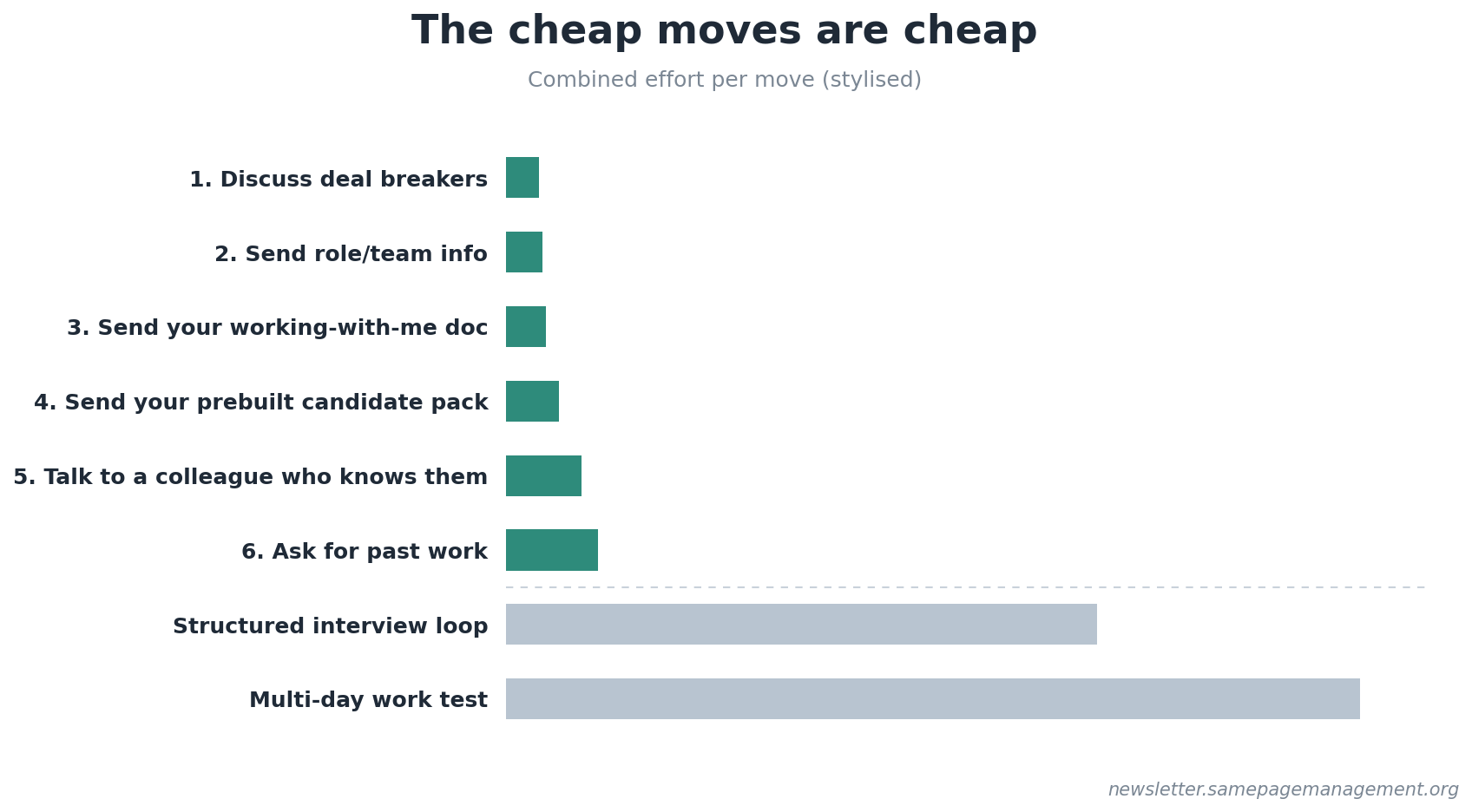
Making a judgement call on which one to run
It’s very valuable to be able to do hiring off-cycle. Being able to consider candidates whenever they come across my radar enables me to hire more people, and potentially some of the most outstanding. It’s a major reason that bar hiring is so useful.
I do find it bloody distracting though.
I find making individual judgement calls on what the next step should be (rather than progress vs. don’t progress), needing to evaluate candidates against my remembered version of the bar, and dealing with the added uncertainty of what people’s fit might be for the roles which I could design is very cognitively demanding.
But getting a large chunk of initial information from a candidate as I describe here often helps. It’s often enough to move ‘whether to investigate’ from a difficult borderline decision to an obvious one, and when it does I can narrow the set of plausible roles by a lot.
Most of the time, I’ll bring in 70% or more of the information here during our discussion and single email follow up. Only then will I sit down and determine whether and what next steps we should take.
I think the primary design criterion of the filtering process is ruling candidates out as efficiently as possible. The major secondary criteria are a) candidate experience, b) ensuring that the likely top candidates remain in the round, and c) helping candidates end the round well equipped to make a decision about whether they should work with you. (Also, sorry about the whole N-dimensional frontier thing. It is tremendously obtuse, but it is genuinely how I think about lots of questions in organisational management, and I find the obtuseness a bit funny.)
Here’s the text I’ll append to my follow-up email:
What work samples are we interested to see? We’re keen to see as much as you’re willing and able to share — but to give you a sense, past candidates have shared ~4–6 documents. I appreciate that much of your work might be confidential, so if you need to amend the documents or can’t send that many examples, that’s fine!
Examples I can imagine being particularly helpful to send (roughly from most to least helpful): 1) documents where you’re making a recommendation or thinking through a complex decision; 2) any policy documents you’ve written or comms sent to the team on a particular issue; 3) anything related to management — e.g. feedback you’ve written for direct reports, blog posts/internal memos on how you think about management, meeting templates you’ve designed; 4) project plans or proposals; 5) processes you’ve designed.
The work will most naturally be from work, but if you’ve written anything like this outside of work (e.g. thinking through a career decision), that’s valuable too — they don’t all have to be work related.
The skills I’m particularly interested in investigating with this are: 1) reasoning ability / judgement, particularly when making decisions under uncertainty; 2) reasoning transparency; 3) clarity of written communication.
If you have anything you think I should keep in mind as I review these, please let me know! For example, maybe a piece was done under unusually high time pressure, or you now think that you would approach the particular problem in a substantively different way.
Some inspiration: Introduction to the 80,000 Hours operations team; Claire Hughes Johnson’s “Work With Me” doc; 80,000 Hours’ about page; Open Philanthropy’s Vision & Values; “Working at Wave is an extremely effective way to improve the world”; “Joining Wave”; “What’s surprised me as an entry-level generalist at Open Phil”; “Thoughts on my experience working at GiveWell”; and pieces in the EA Forum’s Working at EA organisations series.
If I know someone the candidate has worked with reasonably well, I don’t think that I’m obligated to ask permission before speaking to them (especially if it feels more like a ‘chat’ than a ‘formal reference’). If I don’t know them well, I will ask for permission, ideas for who to speak to, and contact details. (I’m not terribly sure about what’s best here and I think the etiquette is somewhat undefined here, but FWIW that’s the approach I take 🤷)