

It’s often difficult to extract useful information about a candidate from their referees.
The referees usually want to help the candidate get a nice job, they might worry about legal risk, and they just don’t have much reason to help the organisation make the best decision.
EA references aren’t like this.
EAs care about the mission of one another’s orgs and tend towards literal communication over false social niceties.
If you’re a hiring manager, you need to be aware of these cultural differences to avoid miscommunication.
If you’re used to the EA world and you’re getting a reference from a non-EA referee, you might over-update on effusively positive feedback.
If you’re used to the non-EA world and you’re getting a reference from an EA referee, you might update too negatively on concerns.
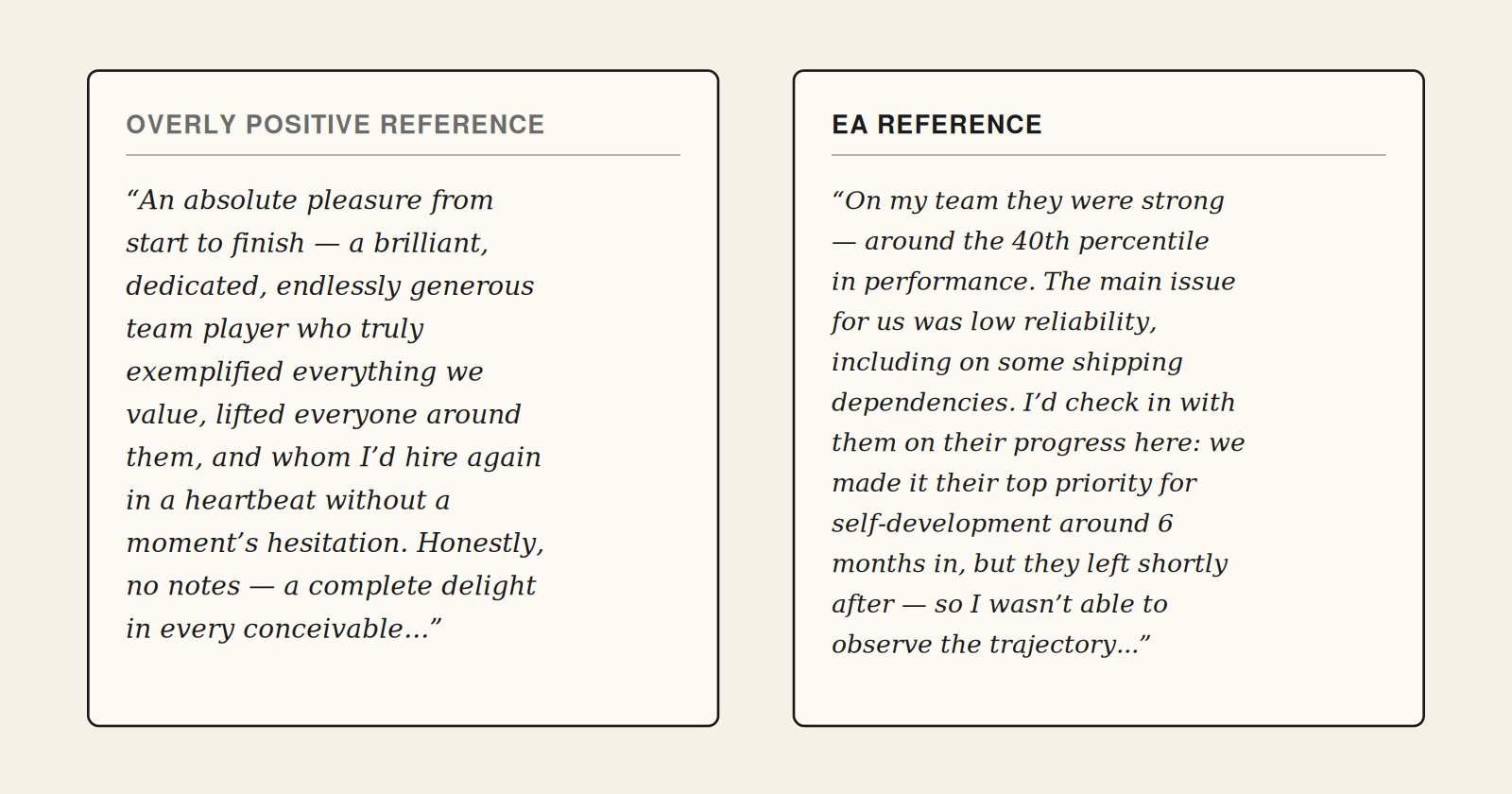
In one hiring round I was involved in, we spoke to a referee who said that they wouldn’t hire the candidate again. In another, a referee told us about a case where the candidate had treated others poorly.
Those references would have been strong red flags outside EA. But in the context of an EA reference, they might just be yellow flags. The right approach was for me to understand what happened, look into the concerns myself during the trial, and ultimately to make up my own mind about whether to make the offer.
Ideas for getting a useful reference
Confirm sharing permissions. Offer options: a) just you, b) anyone involved in the hiring process, or c) a short pre-approved list of names.
Act early. Ask for references before the final stage, not after. You want to find out about uncertainties early enough to test them. You also need to avoid putting the referee in a position where their reference will seem like the only reason an offer didn’t come through. Never say ‘offer made, pending references’.
Ask the unknown-unknowns question. “What would you want to know, if you were me, thinking about hiring this person?”
Ensure you’re calibrated on the level of performance being discussed during the conversation. Are there people who you both know who you can compare the candidate to? When they say that the candidate’s project management skills are strong, does that mean relative to a 30th percentile or 70th percentile seniority role at your org? If they drop balls, how large and how often?
Outside the EA movement, employment references are often performative: getting anything you can really update on can feel like drawing blood from a stone. Inside, they often exemplify an attitude of collaborative truth-seeking which I deeply appreciate. I can speak to someone who genuinely wants my organisation to make the right call, and who works with me to give the most useful, well-calibrated information that they can.
In the references I mentioned above, we looked into the concerns and discussed them with the candidate. In one case, we tweaked their initial responsibilities a little, setting them up in a role we were more confident they'd succeed in.
In both cases we made the hire, and I’m very glad that we did.