

Defining slot vs. bar hiring
I’m fairly confident this distinction has been kicking around the effective altruism movement for at least eight years. I didn’t invent it, and I’m not sure who did. Claude and I couldn’t find a public write-up of the idea, so I’ve made one.
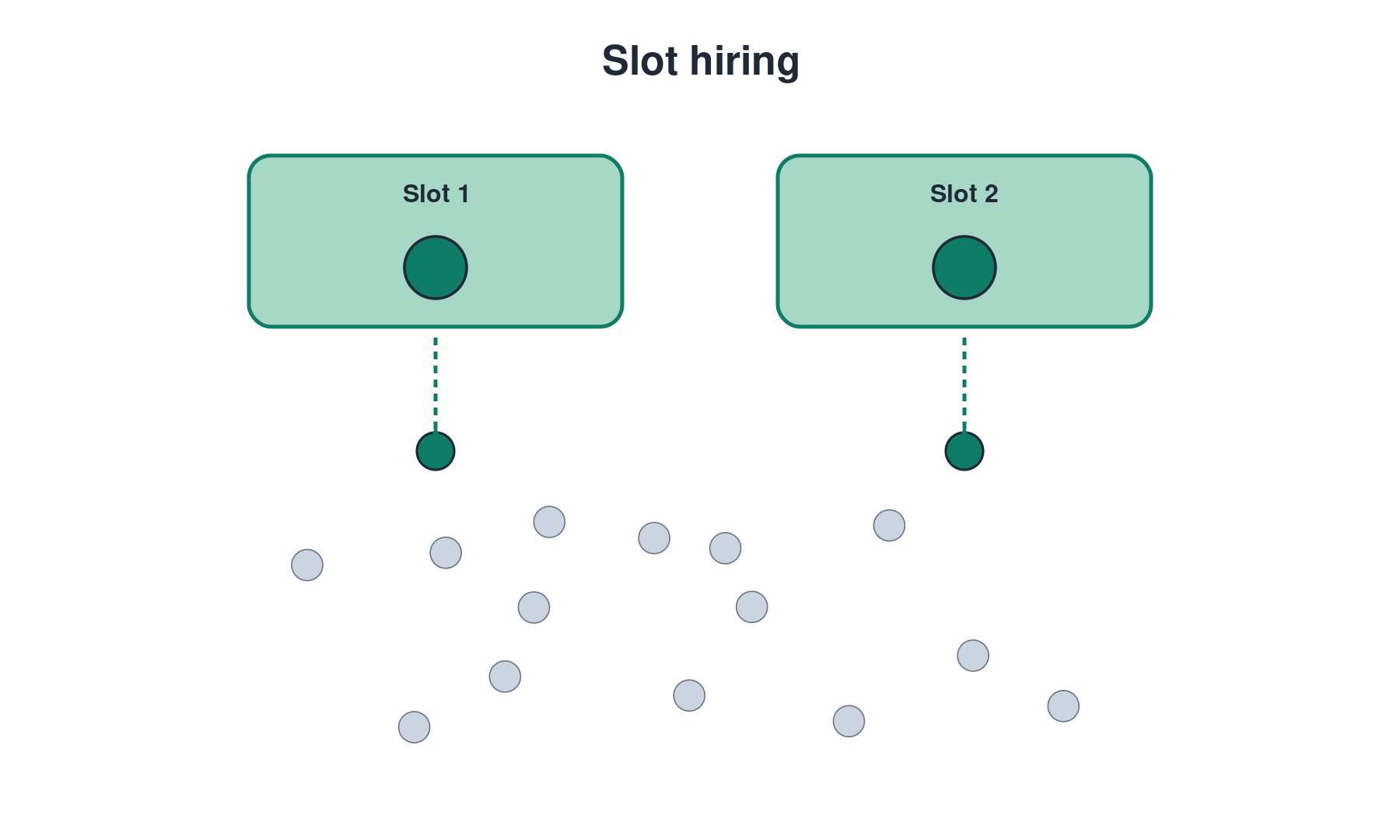
In slot hiring, an organisation decides it has a particular position to fill (or maybe two positions, or more). It runs a hiring round, picks the best candidate it finds, and makes an offer. If that person declines, it makes the offer to the next-best, and so on.
Most of the world operates in slot hiring, so it’s the model most people have internalised for how organisations work.
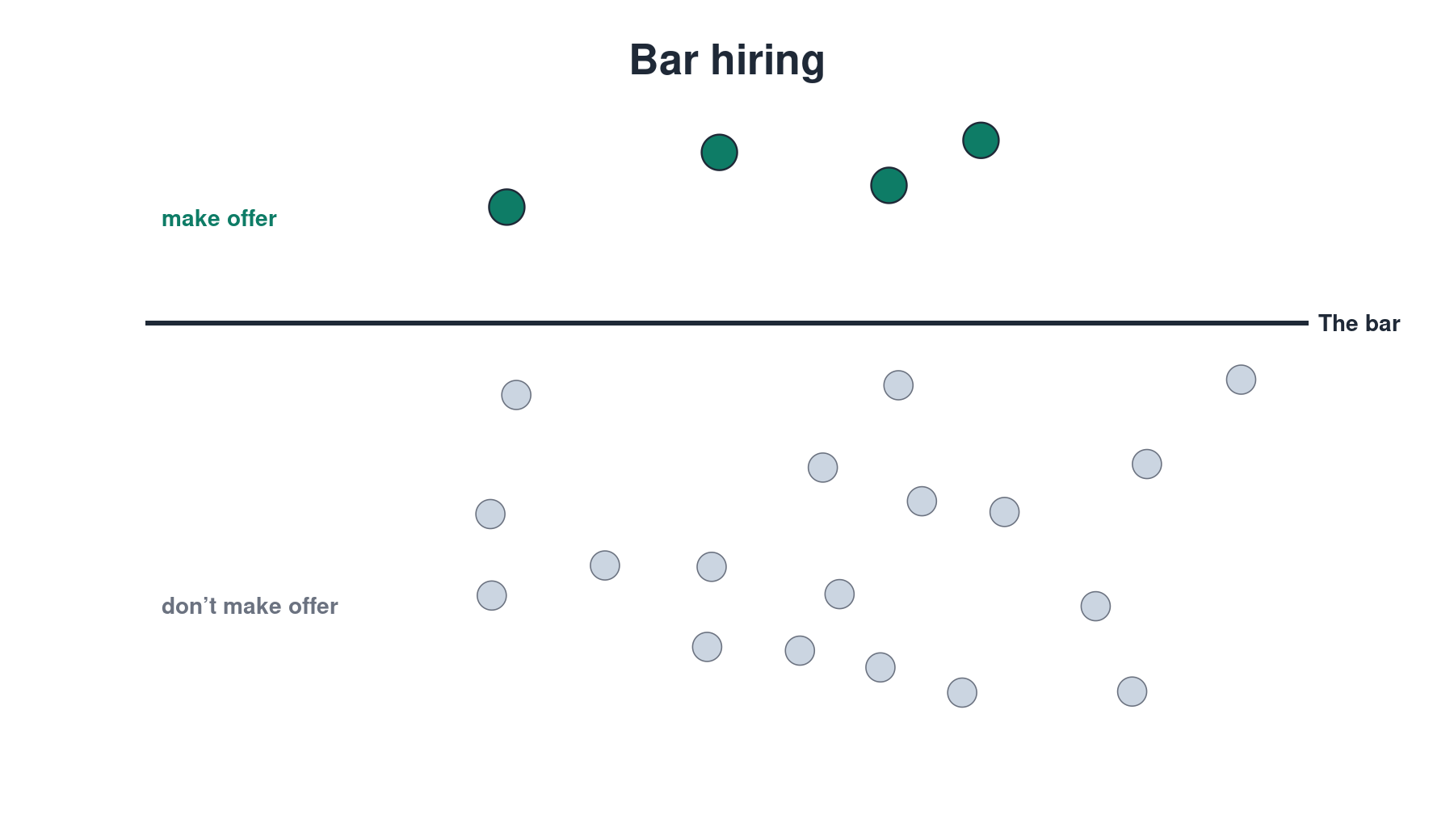
In bar hiring, an organisation defines a threshold of fit and hires anyone above it. The strength of the candidate pool determines how many offers are made.
Thoughts on how to think about slot vs. bar hiring
An organisation wants to hire up to the point where further recruitment stops being the most valuable use of its resources.
The choice between bar and slot hiring mostly comes down to whether we land on that point more reliably by (a) specifying how many hires to make ahead of time, or (b) asking hiring managers to make a judgement call on whether candidates meet a bar.
When to slot vs. bar hire
Here are some key factors which drive that decision:1
1. Is there a steep drop-off in how much value an additional hire can add?
If there’s some very valuable work which ‘must’ be done, but additional work is lower in value, then we’ll get a steeply diminishing returns curve.
For example, in a town of 1000 people, it’s very important to have at least one doctor so that we have someone who can treat the very highest ‘value per doctor time’ conditions (for example, heart attacks and appendicitis). It’s really important to have a second doctor, it’s ideal to have a third doctor, but the tenth doctor isn’t adding much and the 100th doctor adds a trivial amount.
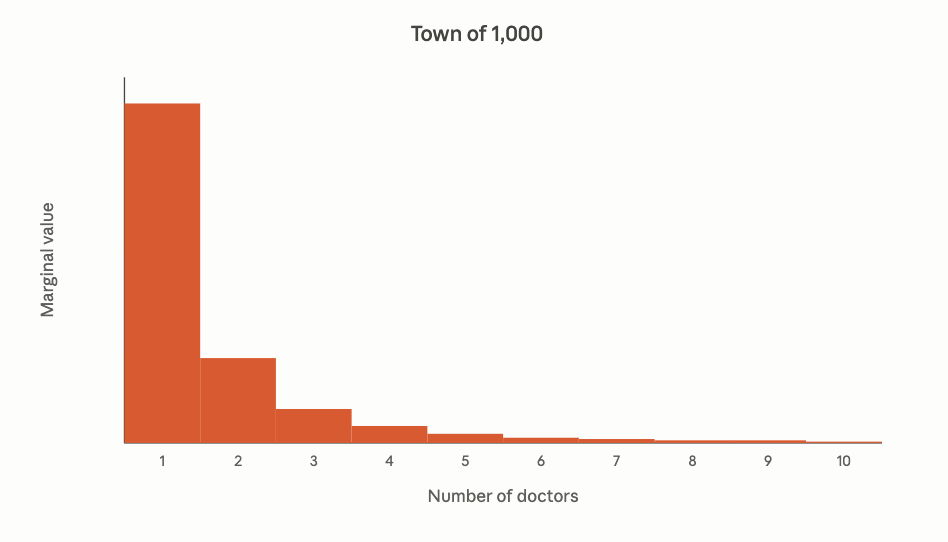
This means that we should try extremely hard to have at least one doctor — and whether to hire is dominated by the number of existing doctors (rather than by their quality). Whereas in a city of a million, the difference in value added by the 1000th doctor is only very slightly less than the 1001st doctor.

When you’re building an organisation and looking to create roles which you can ‘bar hire’ for, you want to look for places where you expect the curve to be gradual rather than steep.
(I’ve written about this in proven talent profiles.)
2. Is there a steep drop-off in how strong your top candidates are?
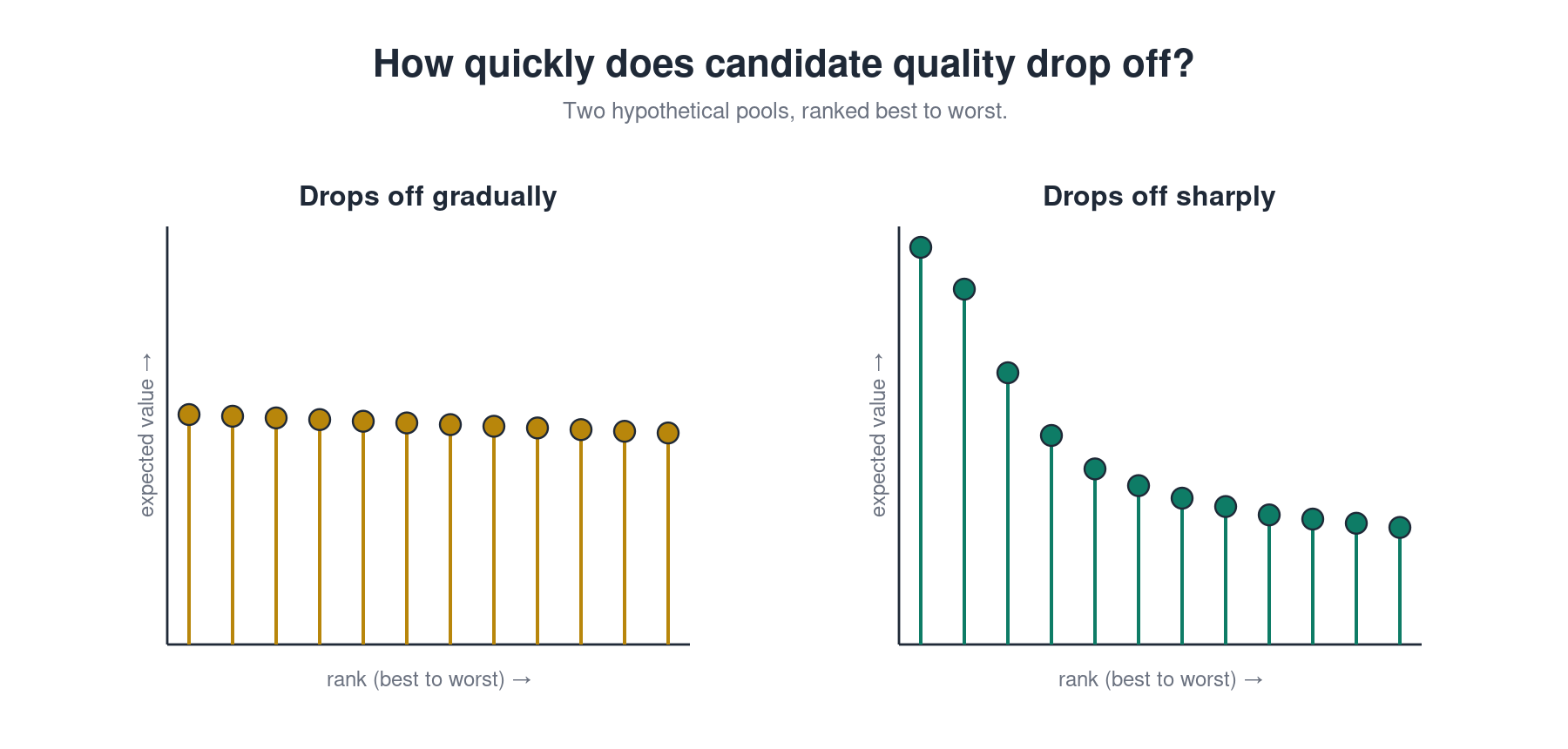
A gradual drop-off favours slot hiring. You can figure out the ideal number of hires to make before you start hiring, because the decision about whether to make 1 or 3 hires isn’t very dependent on the specifics of who turns up.
I expect the best way to know the shape of your curve is with experience, or asking others who have experience.2
3. How effectively can your organisation execute on hiring staff at the bar?
Specifying a number of hires to meet is very legible. In contrast, specifying a bar is complicated and difficult for leadership to verify.
By using slot hiring, organisations are often guarding against principal-agent problems where staff take actions which benefit them rather than the organisation — for example if a manager wanted to hire a large team because it’d look good on their CV. Giving a manager a set number of slots rather than asking them to make a judgement call on the bar is one way to reduce these.3
But as leadership and hiring managers are more synced up, bar hiring becomes more possible. And, if you can make it easier to determine whether a staff member meets the bar (for example, by building a process around a set of proven talent profiles), you can increase how legible the bar is. That will make bar hiring more attractive.
Navigating the bar shifting up and down
Where the bar should sit moves up and down over time.
As above, this is because an organisation will want to hire up to the point where further recruitment stops being the most valuable use of its resources — and that point will be subject to many changes as strategy and the relative importance of bottlenecks shift over time.
For example, if a huge number of applicants suddenly turned up who all cleared the current bar, management capacity would get overwhelmed, onboarding systems would get overwhelmed, you’d run into a funding bottleneck, and so on.
Or consider an advocacy nonprofit, one which wants a fundraising function, a research function, and a content or marketing function. Its impact is roughly the product of their strength across these three areas.
If the marketing function is already strong and already covering the most valuable work, adding additional marketers will add much less value than improving either of the other two programmes.
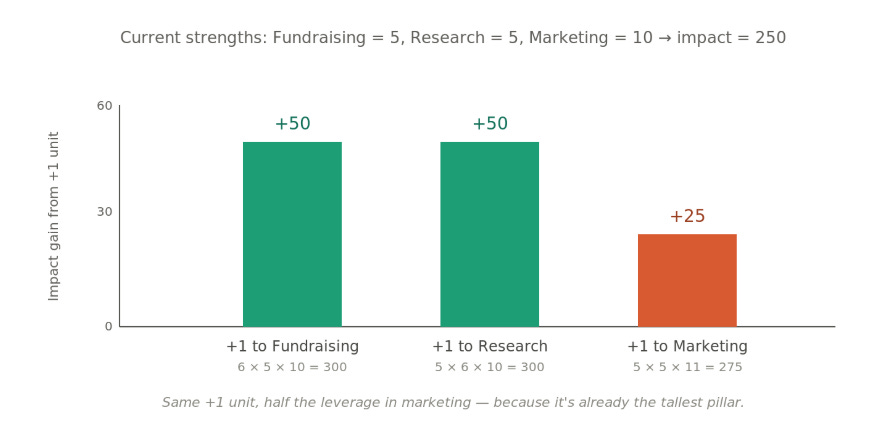
But it can get worse than that. If we model a marginal marketer as drawing on some org resources which might otherwise be used to improve the other two programmes (for example, CEO attention, funding, recruiting team support), the cost of a marketer could reach or exceed the benefits.
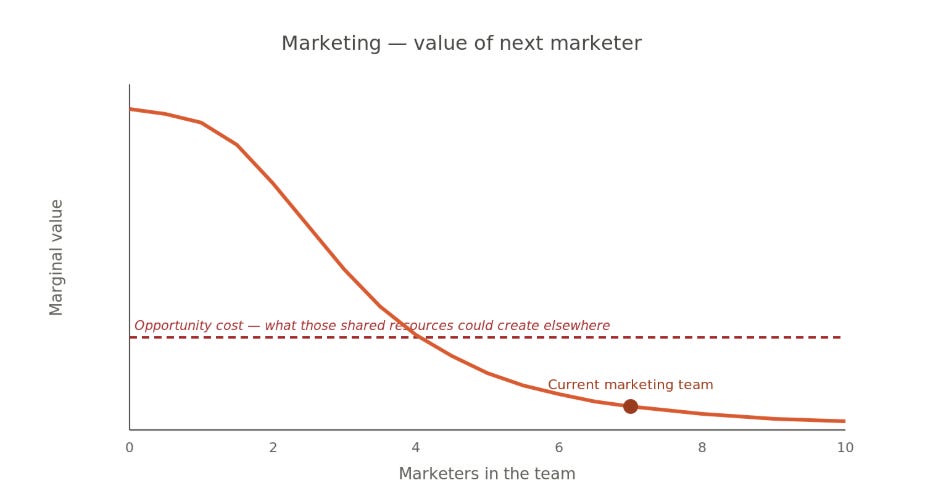
In this case, marketing has moved into a steep drop-off scenario, and you should raise the bar until you’re only hiring marketers who are so strong that they add enough value to compensate for the opportunity costs.
(I think that the right way to think about this technically is as a production function. I’ve mused on that topic in contexts like 80k’s here.)
Always be hiring
A major advantage of being in bar mode is that it enables you to hire all the time. You can apply that bar to anyone who shows up and evaluate them against it — whether it’s through referrals, networks, side conversations between open rounds, or random messages.
This really is very useful! But it comes with a cost: every time a potential candidate comes on your radar, you need to make the tricky decision of whether to investigate them further.
That’s a genuinely hard and highly context-dependent question.
I have two potentially useful pointers:
Think about it as a value-of-information question.
See if you have any moves available to you which will allow you to make progress rapidly. My ideas are here.
Cross-posted to the EA Forum.
I’m still pretty sure I’m messing up the ontology somewhere. Every time I look at it my view shifts somewhat. If you figure out a clean overview, do let me know!
Rob Wiblin worked this through theoretically in How replaceable are the top candidates in large hiring rounds?
Setting up hiring committees with at least one member from another internal team is another way to help here, as the non-team member can add perspective on the org-wide hiring bar and might notice when the hiring team is biased in favour of making a hire that would be unwise for the org overall.