

Epistemic note: I don’t feel pleased about the conceptual clarity of this piece. I bet it could be improved / restructured, but I’m putting it out in the interest of Actually Publishing. I may improve it later.
Organisations often hire people to work on specific responsibilities. In this model, you figure out what responsibilities you need someone to oversee and then evaluate candidates on how well they could perform those responsibilities.
An alternative approach is to hire based on talent profiles. In this model, you look for sets of traits which allow someone to contribute to your organisation. Then you then evaluate candidates on whether they demonstrate those traits.
It’s especially useful if you can find talent profiles which are ‘robust’ — in that someone with that set of traits will nearly always have valuable work for them to do at the organisation.
Example talent profiles
At 80,000 Hours, we have three particularly robust talent profiles:
Advisors
Capabilities: an understanding of 80k’s views and the interpersonal / analytic skills to navigate a complicated (and ideally life-changing!) conversation.
Example responsibilities: (primarily) advising calls, but also running workshops, headhunting for other high-impact organisations, and contributing to our public-facing writing.
Operations generalists
Capabilities: project management, high and reliable output, and flexibility across projects.
Example responsibilities: organising a retreat, negotiating an office lease, running a hiring round, scaling up a large book giveaway, fundraising.
Writer/researchers
Capabilities: good writing, careful research, and an understanding of 80k’s views.
Example responsibilities: writing career profiles, writing problem profiles, research for the podcast.
I think that Coefficient Giving’s approach to its generalist grantmakers and its business operations staff is also consistent with ‘robust talent profiles’.
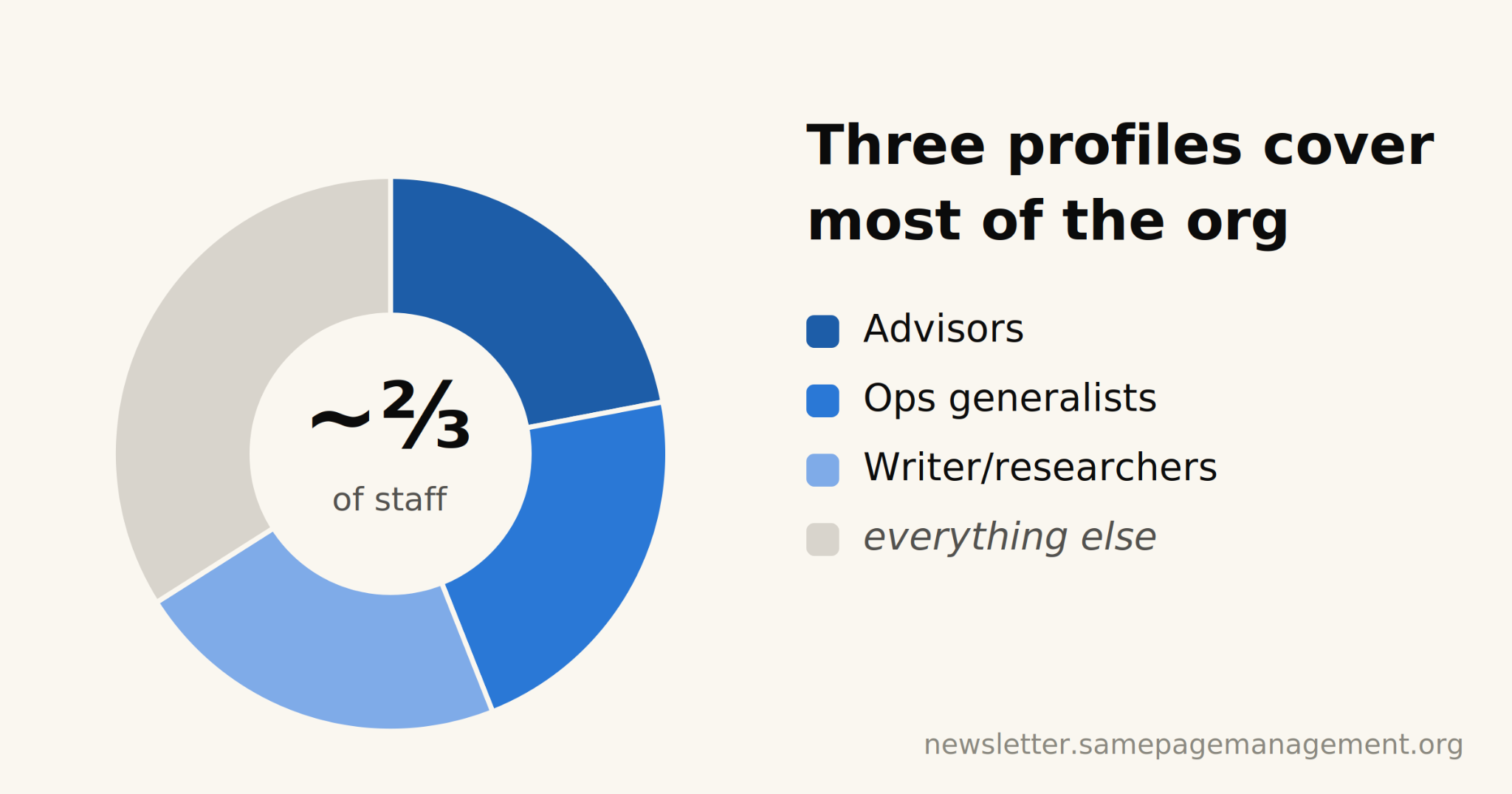
Most of 80k’s hires satisfy at least one of the three talent profiles, but only a minority of our staff have the name of their talent profile in their title.
Sometimes, the role only demands the characteristics of the robust talent profile, but we already know what people’s initial responsibilities will be, so we go for the extra specificity.
Sometimes, the role demands someone with the baseline profile as well as some extra requirements.
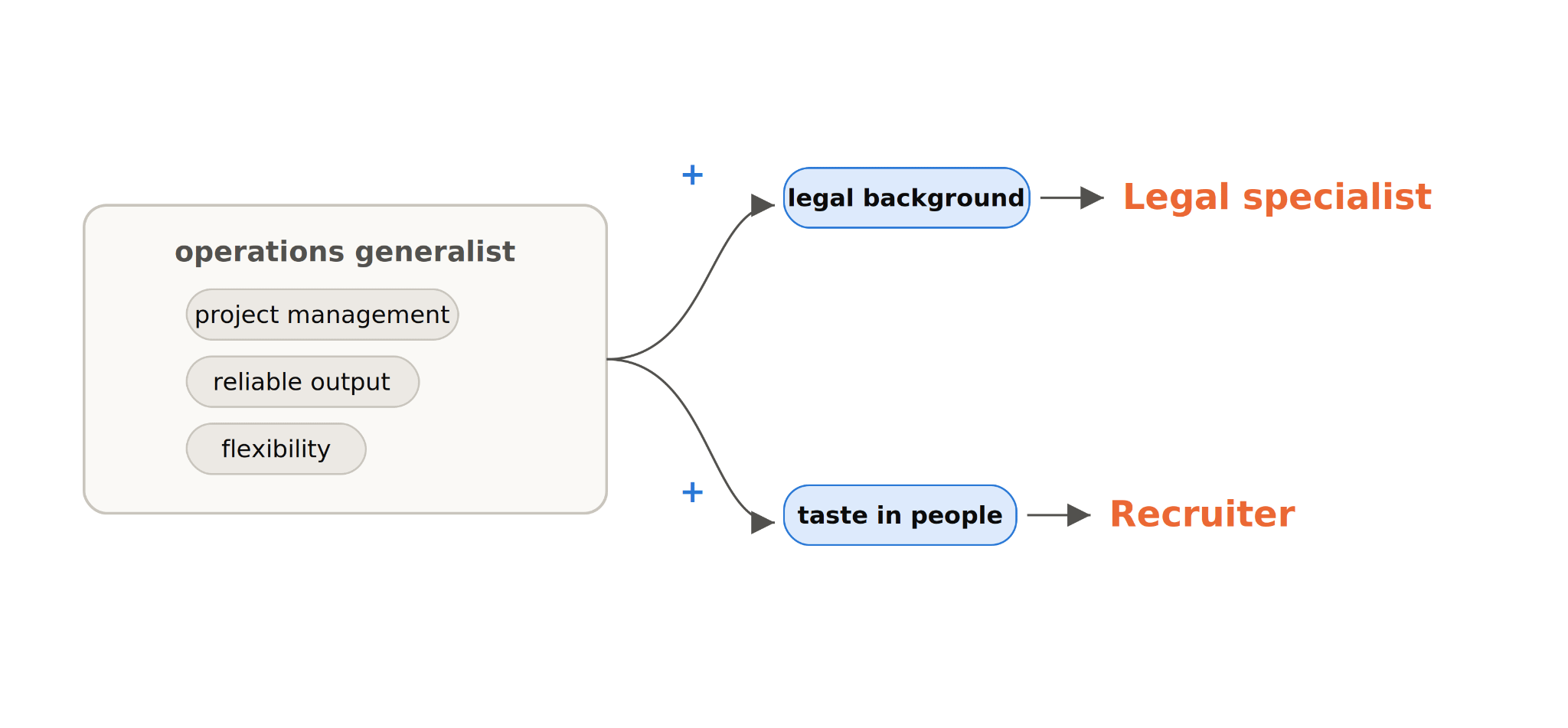
For example, when hiring recruiters, we’re looking for ‘Operations Generalist profile + recruiting-related skills/experience/qualities’, and we’ll advertise the role as looking for recruiters.
This can also happen when people move from a role which only demanded the baseline profile over to a role which needs extras. For example, Balázs Rapi was a lawyer who started with us as an operations generalist. We didn’t hire him specifically because of his experience in law, consulting, or tech policy, but we expected that they’d be useful. When we became large enough to need more capacity in governance, we moved him to a role that would use that background, and he’s now our Legal & Governance Operations Specialist.
Why define robust talent profiles
Easier workforce planning
If someone has one of these sets of capabilities and is otherwise a good fit for 80k, they’re likely to be able to contribute a lot to our mission.
This is because a) there is a great deal of valuable work for these profiles to do and b) we’re well-practised at figuring out if someone does have one of these profiles. (In this way, 80k satisfies two of the three enablers of ‘Bar hiring’: there’s no steep drop-off in value from additional hires, and we can execute on hiring at the bar well).
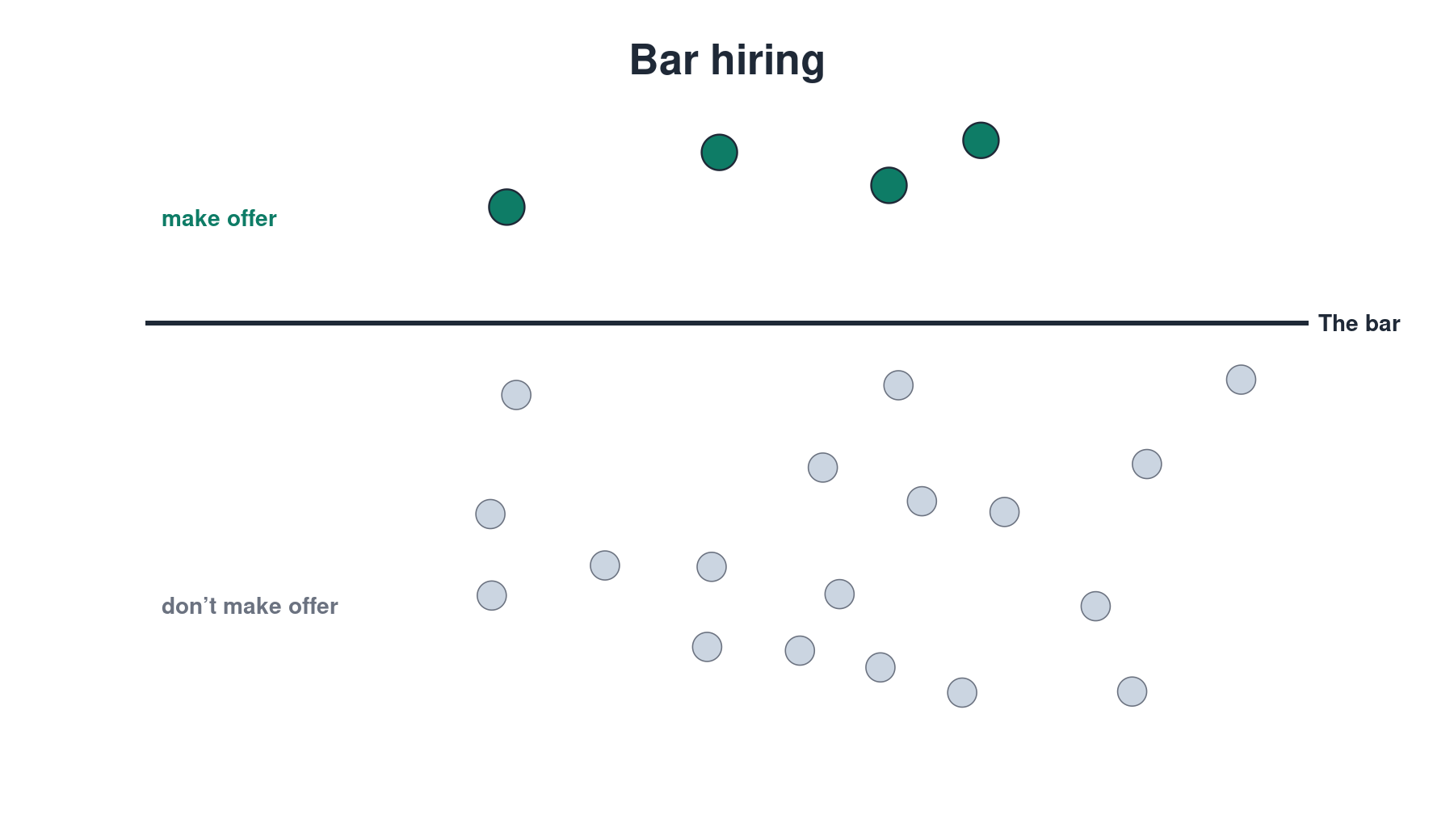
This manoeuvre means that we’re not trying to predict when a particular set of responsibilities will come up and designing roles around those particular responsibilities. Instead, we’re thinking, ‘We might need approximately this many people, of approximately this shape’ — which is simpler.
This gives you a lot of flexibility too. For example, we were able to set Luisa Rodriguez’s start date to ‘whenever she finishes work on the book What We Owe the Future’. We were very uncertain about the exact date she’d finish, but that detail didn’t matter much, because we knew that we’re ~always keen to hire more writer/researchers.
You learn how to work with the profile
You can reuse the hiring process — the same work tests and interview templates — which makes it easier for your recruiting team to learn to run hiring rounds (rather than needing the hiring manager to). You reuse the hiring bar: you learn to recognise what good looks like for each profile, and you can apply that from one hiring round to the next. Over time you can create profile-based development rubrics; managers who are managing similar types of people can more quickly develop intuitions about how best to support that kind of person. You even start to learn how people with the profile tend to move and progress over time.
You can hire many people at once
We can advertise for multiple roles which require (for example) the baseline operations generalist profile (e.g. legal specialist, recruiter, business operations, finance associate). We assess everyone as operations generalists (plus some people for legal / finance / recruiting ability), and then make offers to candidates for each of the positions that they meet the bar for. This roughly halves the organisational capacity required to make a given hire.
It appeals to (some) candidates
Lots of people, especially junior people, are looking for their early roles to give them some chance to explore. If they are hired to fit a profile rather than to carry out a specific responsibility, it’s clearer to them that we will approach their development with this in mind.1 This includes hires moving between teams, which has been common for us (for example, Jess Binksmith (operations generalist → Chief of Staff) and Sam Haskell (tech-focused operations generalist → tech systems on headhunting)).
Limitations of talent profiles
It won’t get you all the skill sets you need
You might be able to tack assessments for a given skill set on top of one of the robust talent profiles, but as the skills get rarer and more specialised, this seems increasingly infeasible.
It only appeals to some candidates
The flip side of the ‘exploration’ benefit: people who want a specific, well-defined role can find profile-shaped positions less attractive.
Role discussions are an ongoing task
You're effectively kicking the can down the road on some role decisions, so you’ll need to figure out what comes next for your staff earlier. That's a whole thing. At 80k, we deal with it through tour-of-duty-style commitments, coordination of responsibilities during quarterly planning, and conversations where we try to be open about organisational priorities and people’s role satisfaction.
Hiring by talent profiles isn’t a novel approach! I was first introduced to it by a friend at a startup, and many large-scale organisations have their own versions — for example, the UK civil service’s ‘Fast Stream’, or LVMH’s manager graduate programmes. But it’s a frame that I want to signal-boost among the organisations we write for.
If you have ambitions to scale and you’re spending a lot of time designing and hiring for bespoke roles, consider hiring by talent profiles instead. It might help you hire faster, reduce workforce planning complexity, and give you a supply of people who can turn their hands to whatever the future of the organisation throws at them.
Some hires do prefer more specificity, though. In these cases, I try to gesture at what they might end up doing, and tell them about what past hires in that profile have gone on to do.