

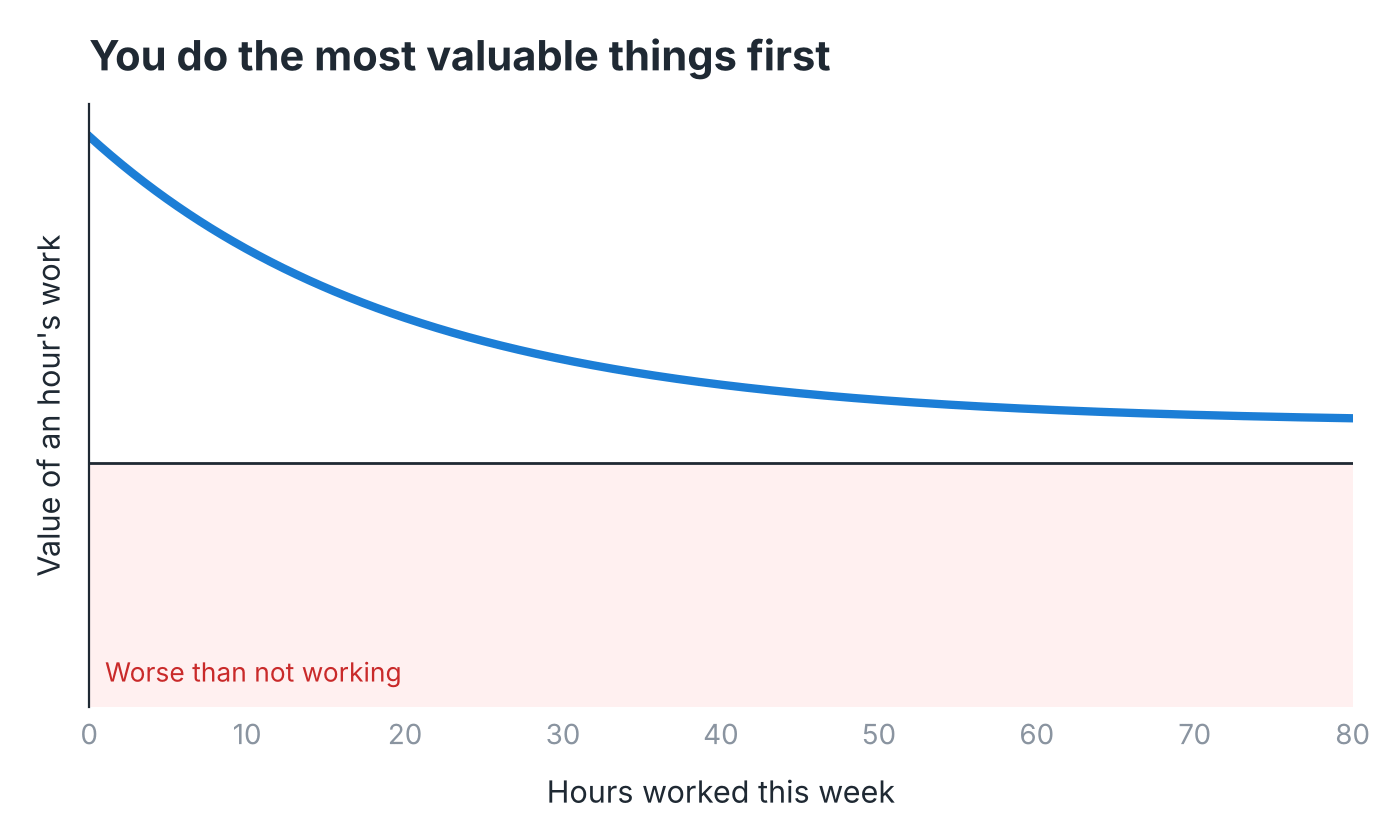
If you prioritise well when you plan your week, you’ll do the most important things first and the less important things later. So each hour you work that week is a bit less valuable than the one before.
In addition, the quality of your work also drops as the week goes on and you get more tired. If you keep pushing anyway, or push on through resistance and frustration, you might work past the point where your brain can think well. Past some point, you’ll make bad mistakes, and the value of your work can drop below zero.
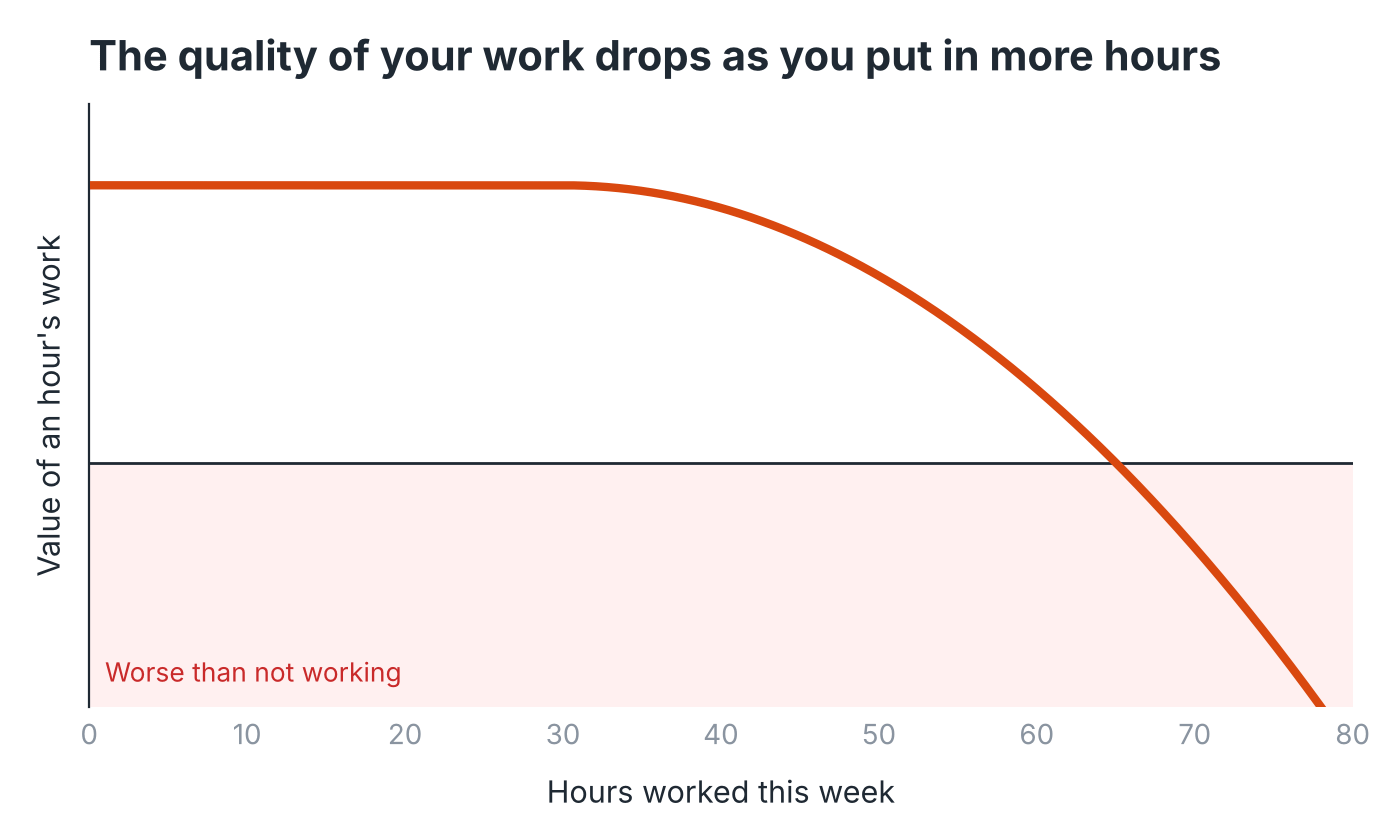
If the amount of time which someone can put into high-quality work was more or less fixed, then the main approach we’d have for increasing impact by optimising work hours would be figuring out where these returns curves drop off and how steeply, and keeping yourself to that.
But it isn’t fixed, as I argue in ‘People can build their capacity for work’. As a result, the main consideration in increasing impact with work hours is about how to get more high-quality time and energy into work and work-related problems.
Let’s say that last week you had a good conversation with your therapist which helped you realise something. You talked to your manager about it, and a whole chunk of work stopped bugging you. Over the weekend, you moved closer to the office, so that your commute isn’t a stressful fight with people for the train at rush hour, and is instead an amble during which you process work-related thoughts. Your new flat has air conditioning, so you slept better than in your old place.
Depending on factors about you, a week like that might give you an extra hour or two of high-quality focused work each day, and better work during your strongest hours.
Your work quality curve moves up and to the right:
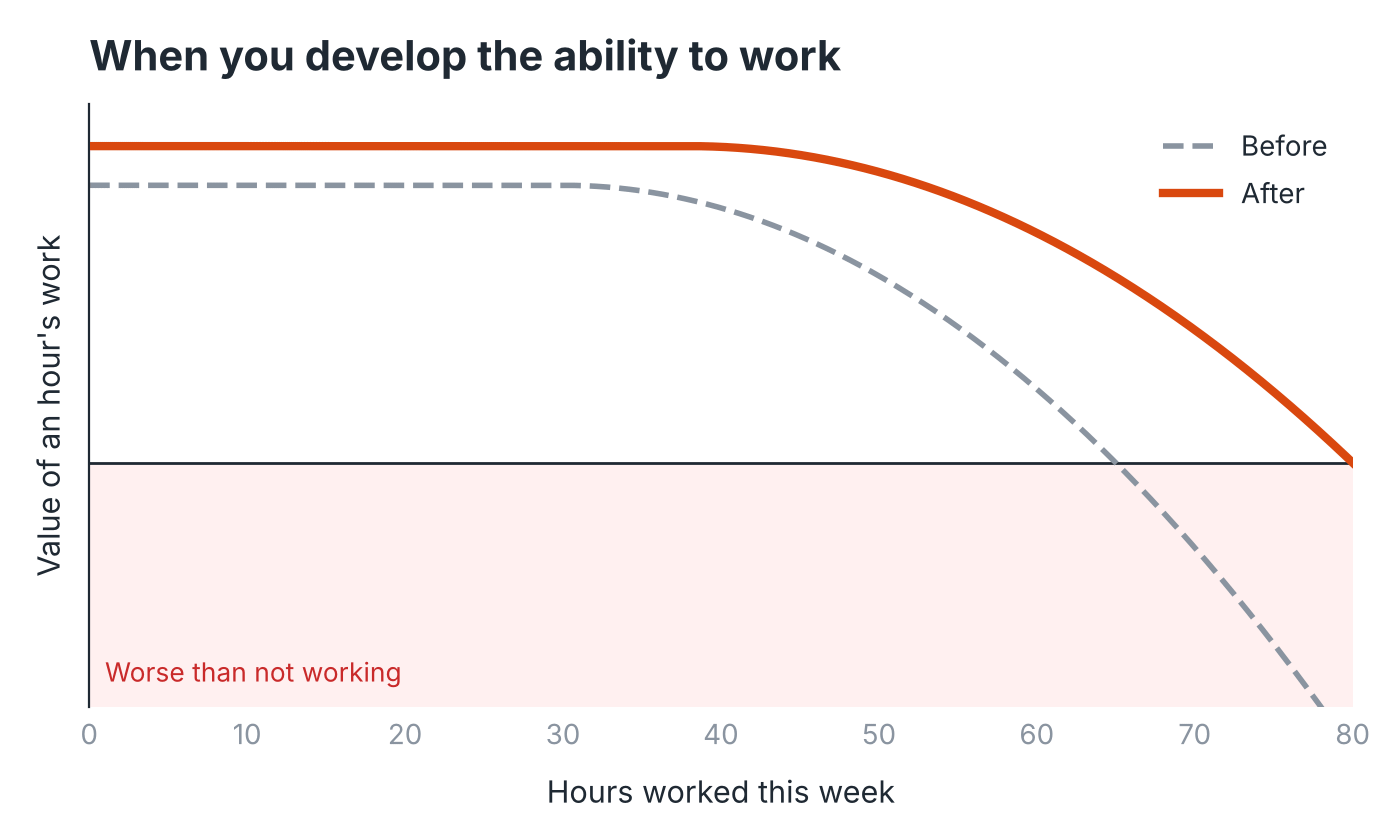
I think of this as increasing your quality-adjusted hours. It’s hard for me to formalise ‘quality’, but I’d think of the highest quality hours as ones where you’re taking the best approach you know of to the most important problems facing you while you’re in the best mindset you have for approaching them.
For me, writing with a coffee beside me at 9AM could be the highest ‘quality’, while mulling over work-related topics on my walk to work is lower, but still positive, unlike the mildly stressful journey on the train.
Lightly pushing myself to add an extra hour in the evening while tired might be positive on most tasks, but negative if I’m tired enough that I make mistakes or get annoyed with someone.
Some people have already tried hard at this, and are close to their (sustainable) limit. But many haven’t, and if that’s you, there are big gains to be had. In fact, I argue that doing so is one way to meaningfully improve the impact of your career.
This matters because, over months to years, there are increasing returns if you can habitually work more while holding the quality of that input constant.
This happens both because you become more capable, and because you’re able to dedicate more of your work time to higher-leverage work.
You become more capable because, over time, you get more repetitions in on emails/speeches/coding/whatever you’re doing; you spend more time on focused self-development; you can strategise more deeply about how best to achieve your goals at work, and so on. You have more leverage because you have more time to put into career strategy / job selection; and because you are so good at your job, people ask you to take on more senior and higher-leverage roles (which in turn help to grow your capabilities and your reputation).
Overall, these lead to superlinear returns to extra quality-adjusted hours.
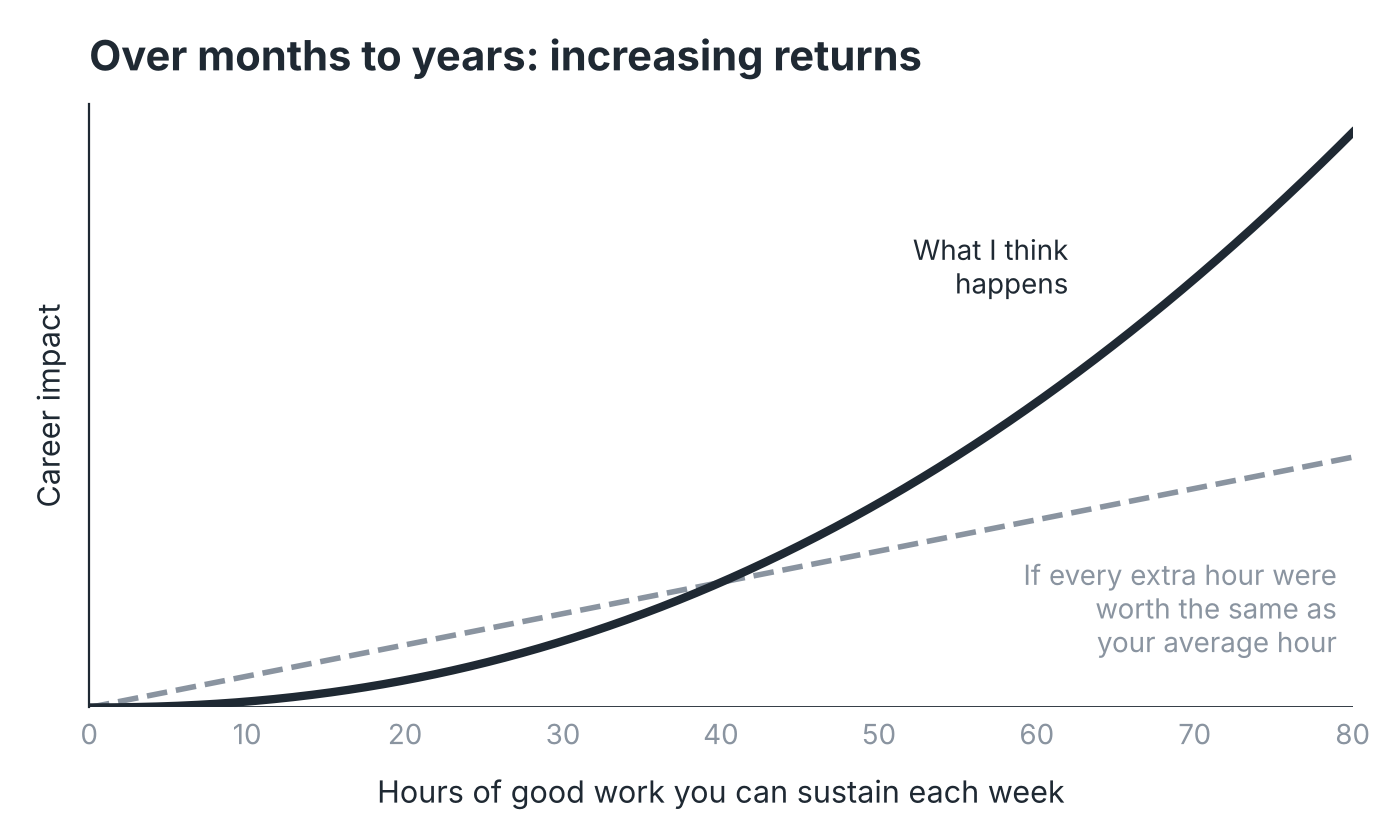
I think the size of these returns, combined with how much most people can increase their hours, makes building your capacity to work one of the largest levers you have on your impact.
Contents
Why make this case?
So, here I am, arguing for the importance of working a lot to effective altruists. That sounds awfully hazardous...
I think that making the case is a good idea anyway.
I think of ‘being able to put lots of time and energy into helping others’ as one of the top few meta-skills for impact, along with prioritisation, emotional self-regulation, and so on. So developing the ability to do so seems like one of the top few tools in our toolbox.
When speaking with people, I’ve learned that many people don’t think about it in this way, and don’t appreciate the strength of the case for increasing returns to investing time and energy into one’s career.
I’ve spoken to three fairly high EA context people doing very important work who have changed their orientation after I synced up with them on the case I describe here. And in a list of internal memos I could make public, the case I outline here was the single most upvoted idea.
So… Yeah, I’m making the case.
Notes on receiving these notes well
But of course there is a good reason that people don’t spend lots of time talking about how people should work and try harder!
Lots of EAs have been burnt out by trying to work long hours unsustainably. Many have spent 100s of hours livid with themselves for not working more and better. I know that many people’s relationship with this topic feels deeply fractured.
Maybe you’re in this ecosystem and community precisely because of your high moral scrupulosity, and maybe the case for becoming more intense on that axis is precisely the opposite of the advice which it would be best for you to hear. Maybe your mental health isn’t in the right place right now. Maybe you’re one of the many people for whom hearing the case for increasing your work would cause you to work more hours unsustainably, then drop out of valuable work for at least some time, and ultimately decrease the value of your career.
While the people I mention in the section above hadn’t heard much of the ‘work more’ case, you might have the experience of the ecosystem constantly yelling at you to do so. People experience the world differently 🤷
If you’re like those people, it’s very possible that you should reverse this advice.
In addition, in the last post I focused on interventions for building your capacity to do more, and left out ones that tend to increase pressure.
But… Umm… Yeah. Pls use your judgement on how to engage here. I want you to thrive.
If you’re not sure whether you’re in the group this post is aimed at, consider the tests in this footnote.1
If you do want to work more, most of the trick is in figuring out how to do it sustainably. Charging at more hours willy-nilly isn’t what I’m recommending. Most people who try to work more go about it the wrong way and burn themselves out: that’s why I wrote about how to do it well in ‘People can build their capacity for work’.
The case for increasing returns
(I’m not quite happy with this post. But I’ve recently argued that with short timelines, it’s less worth delaying things in order to get them right, so here it is.)
This is a complicated topic and I’m not sure which parts of my model are different to yours. So, rather than present a nice clean argument, I’m going to write lots of non-MECE perspectives / takes on why working more gives you increasing returns over time.
If you disagree with me, my hope is that at least one of these considerations touches on a crux between our views on this subject, and you can consider updating your worldview if you’re convinced by it, or push back if you don’t think it’s true.
You get higher-leverage roles
I think most of the returns to working more come from ending up in higher-leverage roles, rather than from doing the same job slightly faster. High-input employees get moved into positions commanding resources. When people see that you’re a bloody force of nature, you end up being asked to take on very important positions, as they know you’ll be able to nail them.
You understand your org better (both the big picture and the specifics)
You might think that once you’re the CEO of a company or the department head of a hospital you can mostly forget about lots of the nitty gritty details.
This isn’t true.
If you understand what’s going on at each level of the org and how to do the relevant work, you’re much better at making high-level decisions related to that work. It takes time to hold both the big picture and the lower-level specifics in mind, so this important strategic work becomes easier if you can allocate more hours to it.
You reduce coordination costs
Much of the difficulty of building an organisation comes from the fact that you want everyone to work in sync with one another. You need to coordinate.
These coordination costs, including hiring, management, culture setting, and so on, are enormous. Most of these costs come per person, not per hour. Each person has to be hired, onboarded and managed, and each has to keep up with what’s going on. Let’s say ‘keeping up with what’s going on’ takes an employee 10 hours a week. In that case, two people working 30 hours each spend 20 of their collective 60 hours keeping up, while one person working 60 hours spends just 10. The two employees also have to stay in sync with each other and hand work between them. So one person working 60 hours a week gets more done than two people working 30.
(The picture isn’t so straightforward in cases where the second employee has an additional ability or specialty that the first doesn’t have.)
Intuition pump: what would 100 hours/week actually look like?
Imagine you have an employee putting in 100 quality-adjusted hours per week, to take an extreme case as an example.
Perhaps they’re your recruiter, who has recently moved from being an individual recruiter to beginning to manage their own team.
What’s the experience of managing them like?
You ask: “How’s it going?”
They say: “Good! The usual reactive stuff took about 20 hours. On top of that I had a big one: my first role sync-up with one of my reports, where we talk through how their role is going and reflect on it. Because it was my first, I talked to HR about how to run it, read the bits of the book they suggested, ran it, and wrote it up. It went well. It was a big investment, but I feel set up to do the next ones better. That got me to about 28 hours. One of my proactive focuses is hiring a Salesforce engineer for our team.”
You say: “Great. Where’s that at?”
They say: “I spent about 25 hours on that this week. To kick it off, I talked to three people about how to think about the role. I had to learn a bit about Salesforce engineering, how the different roles fit together, and how we might want to think about our CRM. I’ve lined up someone who can test the technical skills, drafted the job ad, done the market adjustment for the salary, and worked out the criteria for the role. I’ve also emailed a few people who might know good candidates. It’s in your inbox to sign off before we launch. There are three things I want to double-check with you first.”
You say: “So that leaves about 50 hours of your week?”
They say: “Yeah, that’s right. As you know, we’re in the middle of a hiring spree, so instead of the usual six rounds a quarter, which my two recruiters run, there are ten. I’ve picked up the extra four. It’s been good for me to do it. I have a better sense of what the work is like since we changed the process, which I haven’t had for a while. I’ve written up some new thoughts on training. And one of my searches is one that a report of mine ran last quarter. They missed a few basic things, so I’m looking into those.”
This is a junior person who has just started management, who during the past week has done a tonne of useful work and learned a heap. How long do you think it’ll be before they’re asked to take on an even higher-leverage role?
You get better faster
Intuition pump: 10 extra focused hours for development
Let’s say that someone works 40 hours a week. What happens if they increase it to 50 hours a week and spend the extra 10 hours on reasonably well-targeted self development work?
Perhaps they try to do a part of their job really well (by spending locally unreasonable amounts of time on it). They might use the time to do a course in NVC, learn management, get their head into the org, stay well-networked and up to date on the community, etc etc.
Does it seem plausible that over the long run that they’ll increase their impact by more than 25%?
Relationship and reputation accumulation
More time in the game means more interactions with colleagues, stakeholders, and the broader professional community. This builds trust, credibility, and access to opportunities. The person who’s consistently present and contributing becomes someone others want to work with and promote.
These social assets have network effects, so they add up faster than linearly. Being trusted by person A increases the likelihood that person B will trust you, which opens doors with person C, and so on.2
Skill development compounds
Your rate of getting better at things is roughly proportional to time invested (with some ceiling effects). If you’re putting in 50 hours per week instead of 25, you’re doing twice as much work and also improving at roughly twice the rate.
This creates a compounding effect. After a year, the 50-hour person hasn’t just done twice the work; they’ve also become substantially more capable. Their 50th hour in year two is worth more than their 50th hour in year one, while the 25-hour person is improving more slowly.
You can get a lot better at things with focused work
I’m thinking about the effects described in Anders Ericsson’s book Peak.
When your brain covers the same area repeatedly, you develop dense working models. To others, this looks like it comes from innate intelligence, but it’s actually accumulated expertise from deliberate practice.
This is why the IQ of elite chess players isn’t as extreme as you might expect; what looks like raw cognitive ability is often the product of thousands of hours of focused engagement. These people are able to ‘chunk’ a lot of information about a chess board which they’ve seen into a single unit, whereas less experienced people would use much of their working memory to hold the same information. The more hours you put into an area, the faster you build up these models; and the denser and more detailed your models, the more each extra hour in that area is worth.
Outside view: comparisons with other fields
This claim about superlinear returns doesn’t seem far off what we see in some other fields.
(Note: the numbers below are rough — Claude pulled them from quick searches, not careful analysis.)
Corporate law: A senior family solicitor might work around 40 hours per week and earn around £80–100k. Partners at elite Magic Circle firms earn much more — the average equity partner at these firms made about £2m in 2024/25. I think this indicates more steeply increasing returns than the curve below. (Though I don’t understand what the relative talent of these people is.)3
Medicine: I’m fairly confident that the time in:earnings relationship in medicine for people like me is more steep than the returns suggested below. In the US, family doctors work about 48 hours a week and earn about $290k a year. General surgeons work about 57 hours a week and earn about $440k. So surgeons work about 20% more hours and earn about 50% more. (This compares specialties, so some of the gap is down to training and specialty choice, not just hours.)
Tech founders: Virtually all successful founders are remarkably hard-working. It’s rare to find someone who built a significant company while working 25 hours a week.
Politicians: Similarly, people who reach the absolute top of politics are almost universally high-energy and extremely hard-working.
How much do the returns on work increase?
Dunno.
#vibes-wise though, I’d guess that expected career impact grows more steeply than quadratically with weekly hours.
Suppose I could put in 100 quality-adjusted hours a week instead of 50. I think that would get me a fair way towards being the employee in the first intuition pump above. I’d become extremely useful, so I’d get pulled into much higher-leverage work. And I’d still have something like 10 hours a week for building knowledge and fixing my weaknesses, so I’d also be getting better faster than I am now. The two effects would multiply: I’d improve faster, and each improvement would help me get a role with more leverage, which would help me improve even faster in turn. There are two effects here: the short-run effect of doing more work, and the long-run effect of getting better and moving into bigger roles. My intuition is that the combination of these two effects gets you a more than quadratic increase.
That is, I think the real curve is steeper than this one, which shows impact growing with the square of hours:
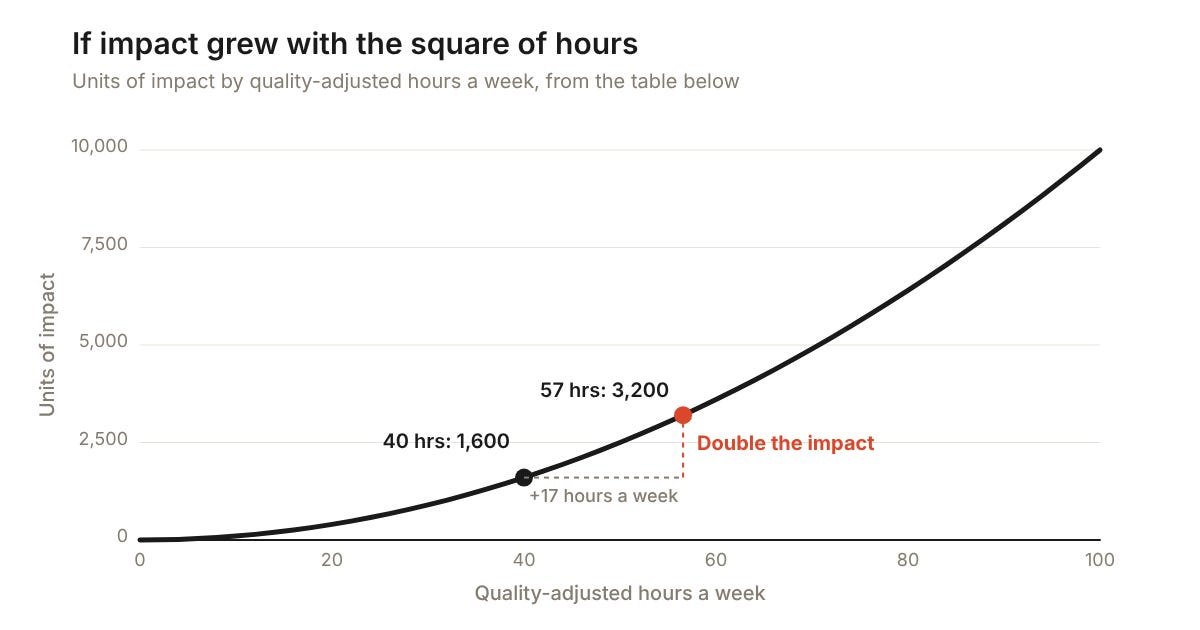
So I’d expect that a person working 57 hours per week would have more than double the impact of someone working 40 hours per week.4
This implies that an extra quality-adjusted hour per week produces slightly more than double the average of the previous hours.
Why people get confused about this
Thinking the answer is better prioritisation instead
When I talk to people about this, they often say that the thing to do isn’t to work more, it’s to prioritise better. I’m not making a claim against prioritisation. I’m arguing for more total time, and I want that time to be prioritised at least as well as it is now.
As I said near the top, I think of working more as one of the top few meta-skills for impact, along with doing a specific task well, prioritisation, emotional self-regulation, and making strong decisions. Part of the reason it’s up there is that it helps with the others (though they often help it too, and they all help one another).
So if you’re arguing for better prioritisation, I don’t take you to be arguing against working more.
Conflating raw hours with quality-adjusted hours
This is a claim about quality-adjusted hours which you’re able to put in year after year.
The picture to imagine here is someone energetic and excited about their work over time, not someone grinding through misery, or just trying to sprint for this next little bit.
I expect that the following cases are negative for people’s quality-adjusted hours:
Working 40 quality hours and then adding another 20 hours by grinding through fatigue and resentment. Those latter hours are extremely low-value or perhaps substantively negative in value. For example, at 80,000 Hours, I think that most of the work people do and conversations people have while they’re ‘Below the line’ are net negative for the world.
Sprinting until your thinking collapses and you make basic errors or strategic mistakes. This is different from forcing yourself to work — you might feel engaged — but you’re in ‘flow’ rather than keeping your head up and ensuring that you’re working on the best thing you can in the best way that you can.
[Special case] Pushing against resistance until you burn out. People have encouraged me to keep reminding folks reading this post of burnout risk, so I’m repeating it here. But it doesn’t really fit neatly, because burning out kills hours directly.
Looking at too narrow a time slice
Even if you’re not resentfully grinding through hours, at the level of a single week, diminishing returns are real. Your task list is roughly fixed, and as you work more hours, you’re picking off increasingly marginal items. (This is decreasingly true as people become more senior and become more likely to own areas of responsibility, but it’s still somewhat true.)
Most of the increasing returns I’m talking about happen over a longer period than that.
The primary mechanism for increasing returns is that over these sustained periods, more hours means faster skill development, more relationships built, more career capital accumulated, the chance to be hired into roles with more leverage where you’ll make higher-leverage decisions, the ability to hire people you wouldn’t have otherwise been able to with your improved vision/sales ability, etc.
To put it starkly, if you work 30 hours / week, then on a given week you will prioritise appropriately: doing your most valuable tasks first, and then your less valuable projects after that. Likewise, if you work 60 hours / week, then on a given week you will also prioritise appropriately: doing the most valuable work first and the less valuable hours after. However, if you consistently work 60 hours per week, you won’t be doing the ‘same’ work as if you’d done 30 hours per week: your work will be higher-leverage, and you will be able to do it better.
Noticing that some part-time staff can add a large amount of value
People like Peter Hartree or Ben Todd can be given a small-scoped advisory role at 80,000 Hours and add a heap of value per hour. But I claim that if they had been restricted to five hours per week of work (and work-related activities) for their entire careers, they would not be at a level where they could do that. The high value-per-hour comes from more than a decade of full-time engagement building up their capabilities.
Thinking “more hours” means “do a better job of everything”
The claim is not that you should spend more time polishing each task. Often you should half-ass everything with everything you’ve got. People in careers like mine aim to spend their time on whatever the highest marginal value activity is to make their responsibilities go better – and they have a reasonable amount of autonomy in deciding what that is. This would be the case if they doubled their work hours too.
Conclusion
Over a single week, extra hours run into diminishing returns. Over months and years, I think they have increasing returns. That’s because more quality-adjusted hours make you more capable faster, and get you into roles with more leverage, which help you get more capable in turn.
In EA, people don’t emphasise the idea that we should be pushing quality-adjusted hours up, for lots of reasons. I think that’s led to many people underappreciating just how important it is. It is important.
Generating time and energy for work-related activities is a foundational piece of self-development. In the last post, I argued that you can increase it over time. If you haven’t tried ~all the ideas for getting more quality-adjusted hours into work in the last post, I expect that it’s worth doing so. Do it in ways that leave you energised rather than exhausted. And if the two tests in the first footnote suggested that you need more rest rather than more work, take that advice instead.
First, is the amount you work now sustainable? Suppose you work hard Monday to Friday and take the weekend off. Do you feel fully recharged by Monday, or more tired than the week before? Could you keep this pace up for months at a time, between longer holidays? If you’re usually recharged by Monday, you could try adding some work at the weekend, and then check again. If you’re not, you probably need more rest, or better rest, before you need more work.
Second, do you want to work more? Do you look forward to work on a Sunday evening? Do you get absorbed in tasks for hours without it being a drag? Do you enjoy talking to your colleagues and the people you work with in the field? If so, working more might even be good for you. If not, I’d first try to redesign your role so that it’s more intrinsically motivating, and only add hours after that.
I feel a bit unsure about how to think about this one tbh. Like, maybe the returns diminish so quickly, or social circles get to saturation so fast before you have to break out again into a new social circle that maybe the returns often diminish….? But at least some people have experienced remarkable snowballing effects here, so maybe it’s right 🤷
I think a lot of this is due to tournament effects, and some of the incentive to work is about getting a shot in that tournament. Something similar happens in medicine. I think most direct-impact roles in EA aren’t like that, though there are some, like elections or being first to market.
Yes I’m talking incredibly weirdly casually here. I hope that this gives a sense that I really am looking at some numbers and making something up. Even within the AI safety ecosystem, there are lots of particular roles which particular people are suited for, and each of those will have different returns to someone being able to work more. It also depends somewhat on AI timelines. Shorter timelines mean that some bottlenecks are relatively more important, which points in favour of higher-impact returns for people who can be central in working on those bottlenecks. OTOH shorter timelines prevent people from developing skills. If you have a take, I’d love to hear it in the comments.