

This post is about what to do when you realise you’re not going to get through everything you’ve committed to.
Of course, in the long run, you can build your organisational and personal capacity to get more done. You can improve your ability to forecast workloads and reduce how regularly you end up with too much on.
That sounds great. You should totally do that.
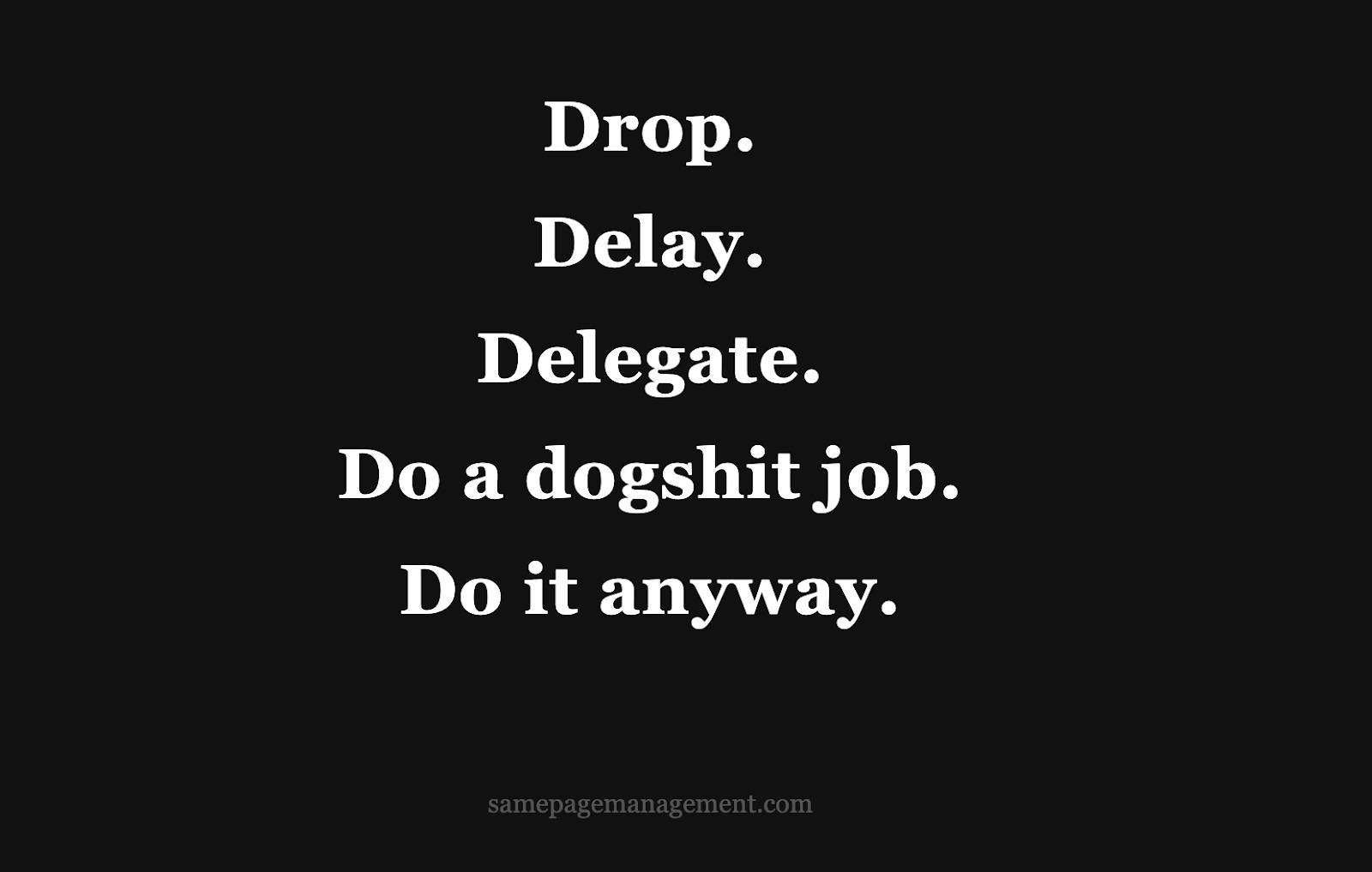
But in the moment, you’ve really only got these five options. Pick one intentionally and then do the best job of it you know how, perhaps incorporating some of my ideas below.
I think that’ll turn out better than grinding through your original plan with more stress and longer hours than you intended.
1. Drop
Dropping means deciding that something probably won’t get done — by you or anyone else.
It’s often the right call, but it can feel hard to actually make the decision.
One trick: talk to someone else about it. Your manager is the ideal person. They’re less emotionally tangled up in whether you complete your plan this week and more in touch with the bigger picture — including your long-run sustainability. They can help you feel like it’s ok to let something go and, if needed, give you the push to do so.
Getting Things Done has a useful reframe here: instead of deleting the task, move it to your ‘Someday Maybe’ list. Putting something on that list doesn’t mean you’ve decided never to do it. It means you’ve decided that future you will decide. (Future you seems like a capable person who has lots of time. I’m sure they’ll get right on it.)
Note that if you’re dropping something you’ll probably also have to let others know that you’re not going to do something they expected you to do.
2. Delay
Delaying is different from dropping: you’re still committed to the task, but you’re renegotiating the timeline. The advice is otherwise ~identical to the advice above.
3. Delegate
Delegation usually means giving a task to someone you manage. But if that were possible, you should have spotted it when you made your plan — so if you’re only thinking about it now, there was probably a reason you didn’t do it then, and that reason is likely still in play.
But when you’re overwhelmed, you might have options you wouldn’t normally consider:
You could hand it to a peer — someone senior enough and high-context enough to run with it. In normal times you wouldn’t ask, but a crunch isn’t normal times.
You could delegate it to your manager. Managers are often empowered to do a much worse job than the people reporting to them, and sometimes that’s the right call.
4. Do a dogshit job
Like, really dogshit.
Your instinct might be to try doing your original plan but faster. Sometimes that works, but it has downsides.
I often nudge people into going one step more dogshit: substantially descoping the project. Instead of doing the old project badly, do a qualitatively different project — one that captures a fraction of the value for a fraction of the effort.
For example, rather than a strategy document, put a paragraph in a #half-baked-ideas channel. Rather than producing a proposal of strong reasoning transparency, message someone your bottom line on what you think (with a flag that you’re low on capacity and an offer to do a stronger writeup if they really need you to).
5. Do it anyway
Sometimes, after considering all the above, you decide that the best option is to do it anyway.
If you’re going to take this option, set it up so it’s not a grim slog. Work on Sunday, but be out by 11am. Set up Pomodoros with friends. I like to time-box my sprints and put something I’m looking forward to at the end — usually a party or a weekend away.