

Too many people in our audience feel uncomfortable with selling themselves.
Fortunately, our audience are also people who might change their orientation in response to an economic concept. Especially if it’s one which reframes selling themselves as a way of helping others.
That concept could be ‘transaction costs’.
Let’s say you’re a freelancer and you’d like to support me in my work at 80,000 Hours.
I’ll need to pay your fee. But I also need to ‘pay’ the transaction costs of acquiring your service.
These transaction costs are:
Discovery — I need to notice I have a need and learn that you can meet it.
Trust — I need to be confident you can actually deliver, and that working with you will be a good experience.
Transfer — I need to actually acquire your service: contracts, onboarding, project management.
Accounting for my value of time, the transaction costs I have to ‘pay’ can easily be the majority of the true cost of working together.
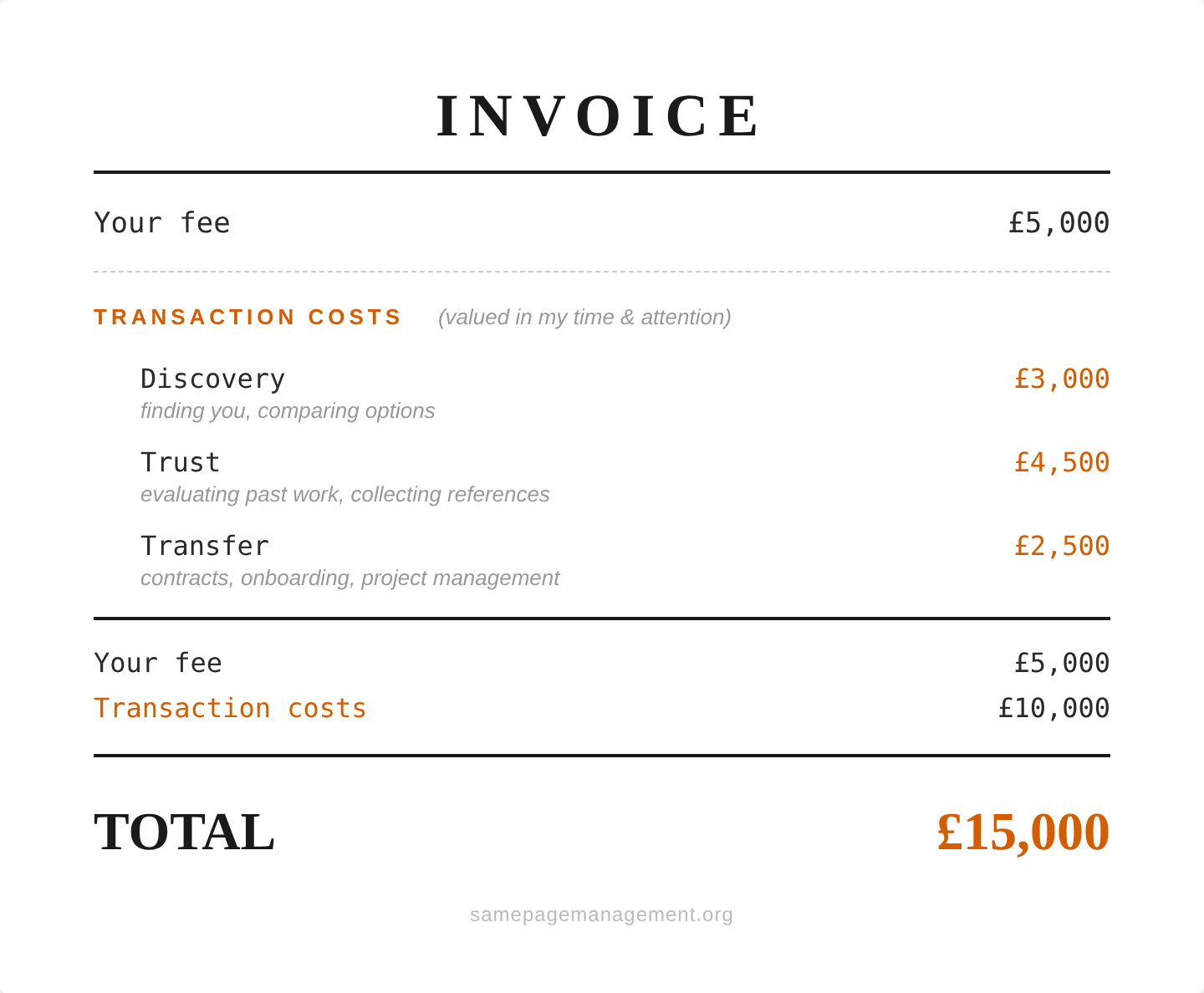
So anything you can do to reduce these transaction costs is very helpful to me.
You’ll reduce my discovery costs if you market yourself enough that I can find you and learn what you have to offer.
You’ll reduce my trust development costs if your writing speaks directly to any concerns I might have. Similarly, my trust development costs will be low if previous clients of yours say ‘hell yeah’ when I ask if I should work with you. (Incidentally, having a trusted brand like this is a route to reducing transaction costs, and it provides a reason to do a better job than would otherwise be optimal.)
Finally, you reduce my transfer costs by making yourself easy to onboard and manage.
(For practical advice on all of this, read Sammy Cottrell’s What They Don’t Teach You in Freelancing School.)
Most of our encounters with advertising and salespeople in everyday life are bad. They don't seriously try to account for the negative effects they have on others.
But if you're trying to make the world better and operating in an environment where you care about the effects you're having on others, you could decide for your advertising and sales not to suck.
You could make your marketing helpful rather than spammy. You can endeavour to give people an accurate picture of what you can do, rather than overselling.
I suggest doing that.
(Note that the effects here travel beyond a single interaction, as described in Communities of do-gooders should be exceptionally considerate.)
This basic structure — discovery, trust, transfer — applies to most of the ways you might want to work with others: hiring an employee, getting yourself hired, finding mentors, research collaborations, and customer acquisition.
In any of these cases, you can enable more productive exchange through work that makes it easier for the other side to find you, evaluate you, and work with you.
Think of it as one of the ways you can help others.