

Underhiring to the 80,000 Hours operations team was one of the most consequential career mistakes I’ve made.
One reason I made the error was relying too much on ‘bottom-up’ reasoning.
That mental manoeuvre was something like:
Figure out which projects need to be done, how long they’ll take, and figure out how many people we’ll need to execute.
If I had thought about that question well, then I could have answered it with the correct answer – and come to the right hiring strategy.
But I didn’t think about it well.
I wasn’t able to think through the details enough to notice everything that would make the work difficult: unforeseen projects, how one’s manager’s small tasks become their big tasks, coordination costs, shocks to capacity like people leaving or going on leave, how much more complicated a 60-person retreat is than a 10-person one, that we would move to a faster growth rate which requires more operations staff, and so on.1
This was made more difficult because my intuition led me astray. Part of me still thought that 80k was an organisation of 10 people, and that part of me thinks that it’s silly that we would need more than one person working on HR. Compound growth do be crazy.
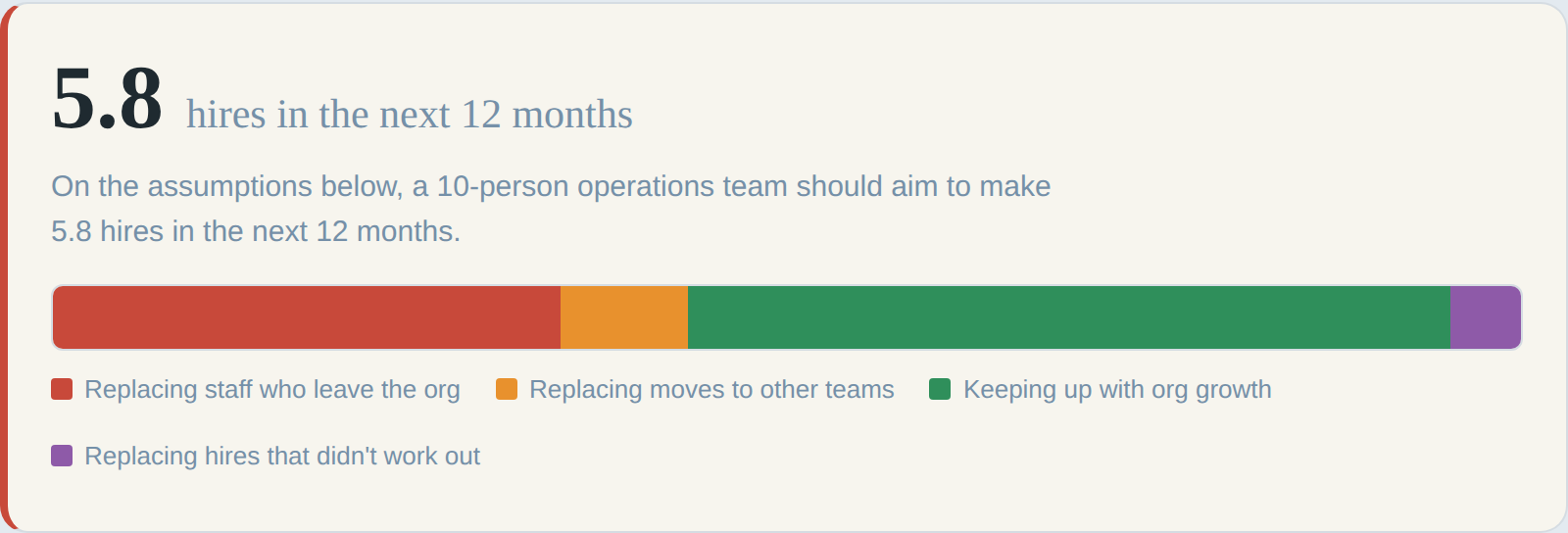
If you’re involved in operations capacity planning, try out this model I made.
You input assumptions about your organisation, whether you’d like to increase or decrease the capacity of your operations team (relative to the org), and it outputs an expected number of hires to make.
It’s only one of several useful lenses on capacity planning, but personally, I find it more useful than the ‘bottom-up’ approach.
Notice that these rhyme with the kinds of mistakes which people make when they estimate the cost of a large building project or how long it will take them to complete a complicated project. The standard solution to these is reference class forecasting.
Just wanted to say I think this is a really valuable post and it should be getting more attention! It's really easy to say things like "we want to double the size of the org in the next year" or whatever, without thinking through the details of what it'll require in practice (and how things will break). I've shared this with a number of my clients and they've found it helpful. Thanks for writing it up!