

The to-do function
There’s some (net) benefit to doing a task. That benefit generally1 declines over time, but the functional form varies a bit.
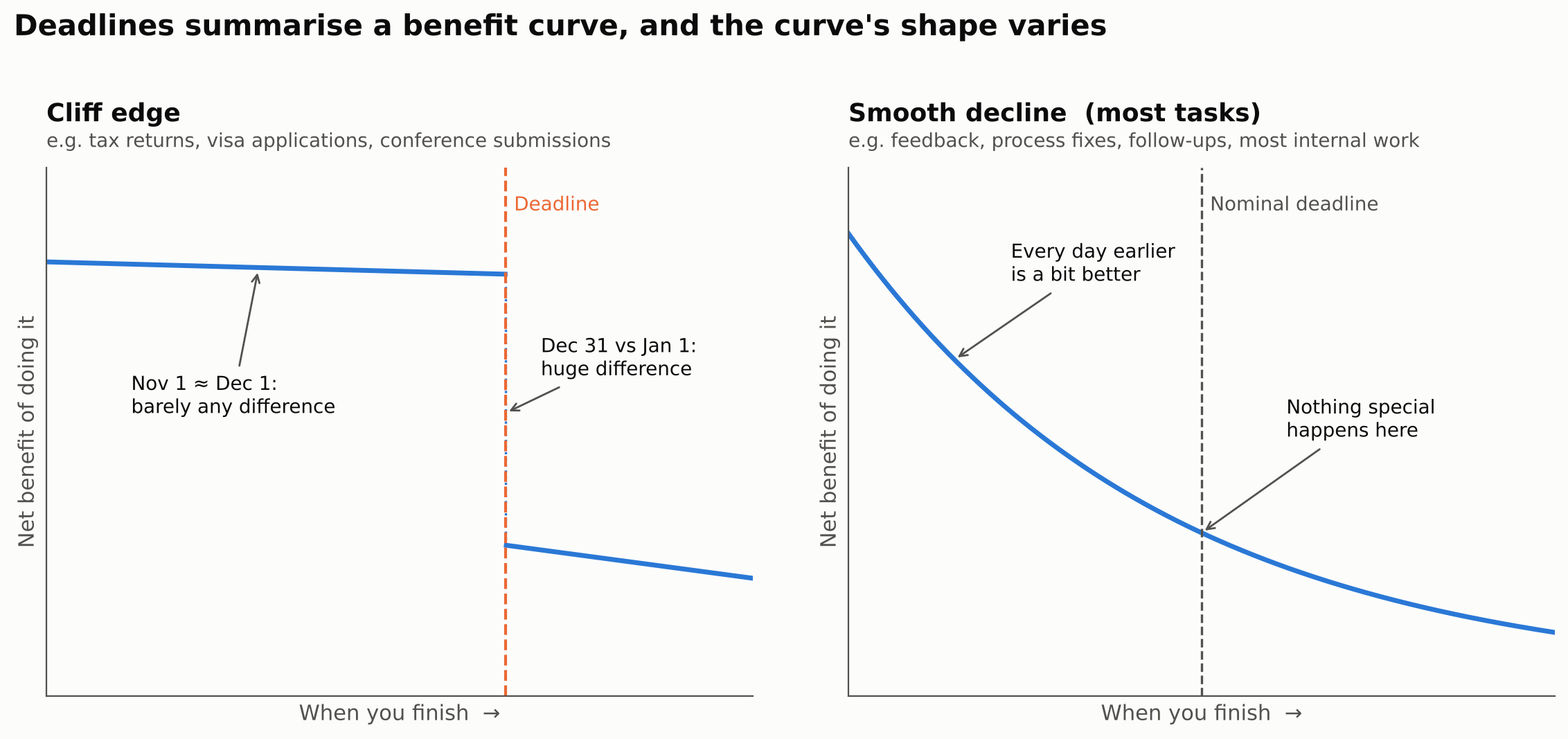
For some tasks, there’s this kinda cliff-edge drop-off in benefit. For example, with a tax return, it’s basically not any better to submit it Dec 1st vs. Dec 31st, but it’s way better to submit Dec 31st vs. Jan 1st.
For other things, I think that the drop-off is pretty slow, or even totally smooth, and it’s just about getting it done sooner. I think that most things are more like this.
Against fake deadlines
In cases where the value of a task diminishes smoothly, I think that setting deadlines at all is a distraction/stress-inducer without much benefit.
I’d rather just know that I’ll do it when I can. This makes me less stressed.
I think not having a deadline also better reflects the reality of the benefit/time curve, which means I can prioritise better: e.g. if I know that the benefit of a task is dropping off smoothly, and a new high-priority thing comes up, it’s easier to switch to the high-priority thing, rather than getting stuck on meeting an arbitrary deadline for the lower-priority thing.
Why still have deadlines?
Sometimes you actually have a cliff-edge case! In this case, I think deadlines are good, and I use them, but this is rare (in my work).
Some people seem to like having a clear deadline to work towards, even if it’s (in some sense) fake. People’s psychology on this varies, so if deadlines are useful to you I think you should use them.
Deadlines can also be a tool for coordination, and it’s important to manage deadlines cooperatively. For instance, if someone else gives you a deadline, try to meet it or renegotiate it.
Two types of deadlines: “Best before” and “Expiry”
I now basically don’t use deadlines at all, but one thing that I tried for a bit and liked is having two dates for tasks:
“Best before”: roughly, the date at which the value of completing the task is most rapidly declining.
“Expiry”: the date after which there is approximately no value in completing the task.
(In analogy to food labels.)
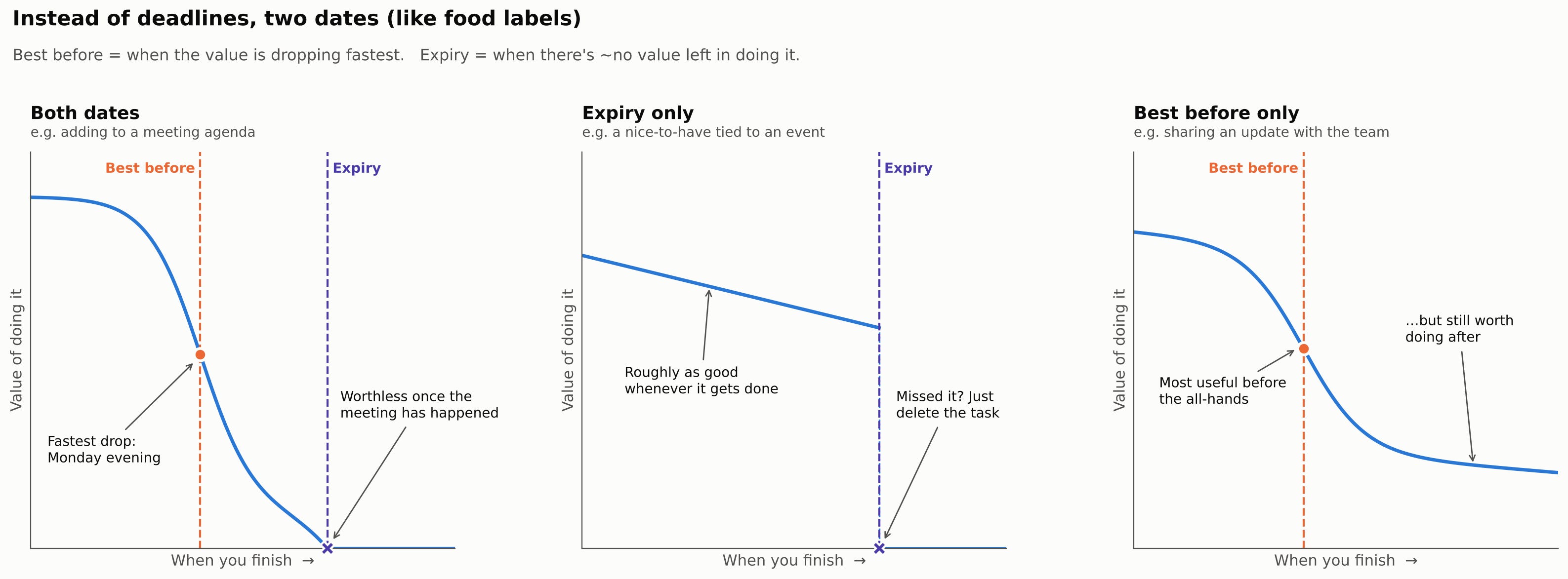
Some tasks have both best before and expiry dates (e.g. it’s best to fill in our meeting agenda by Monday evening, and it’s useless to fill in the meeting agenda after we’ve had the meeting). Some just have an expiry date (in which case, if you failed to do the task by then — for example, because it wasn’t super important — you can just delete it from the list at that point). Some just have a best before (e.g. it would be most valuable to share an update with the team before all hands, but it would basically always be valuable to share it).
This is still simplifying the true thing which is the benefit/time curve, but I think it lets a bit more nuance in.
For some tasks / people, the net benefit increases as you run closer to a deadline:
You might be more motivated to complete the task reducing time/effort
You might have more information about the best way to complete the task
As a special case of the last bullet, you might realise that you no longer need to do the task.