

I sometimes see people communicate advice as a long list of things that they think someone should do.
Lists like this are hard to remember, and so I don’t find them easy to use reliably.
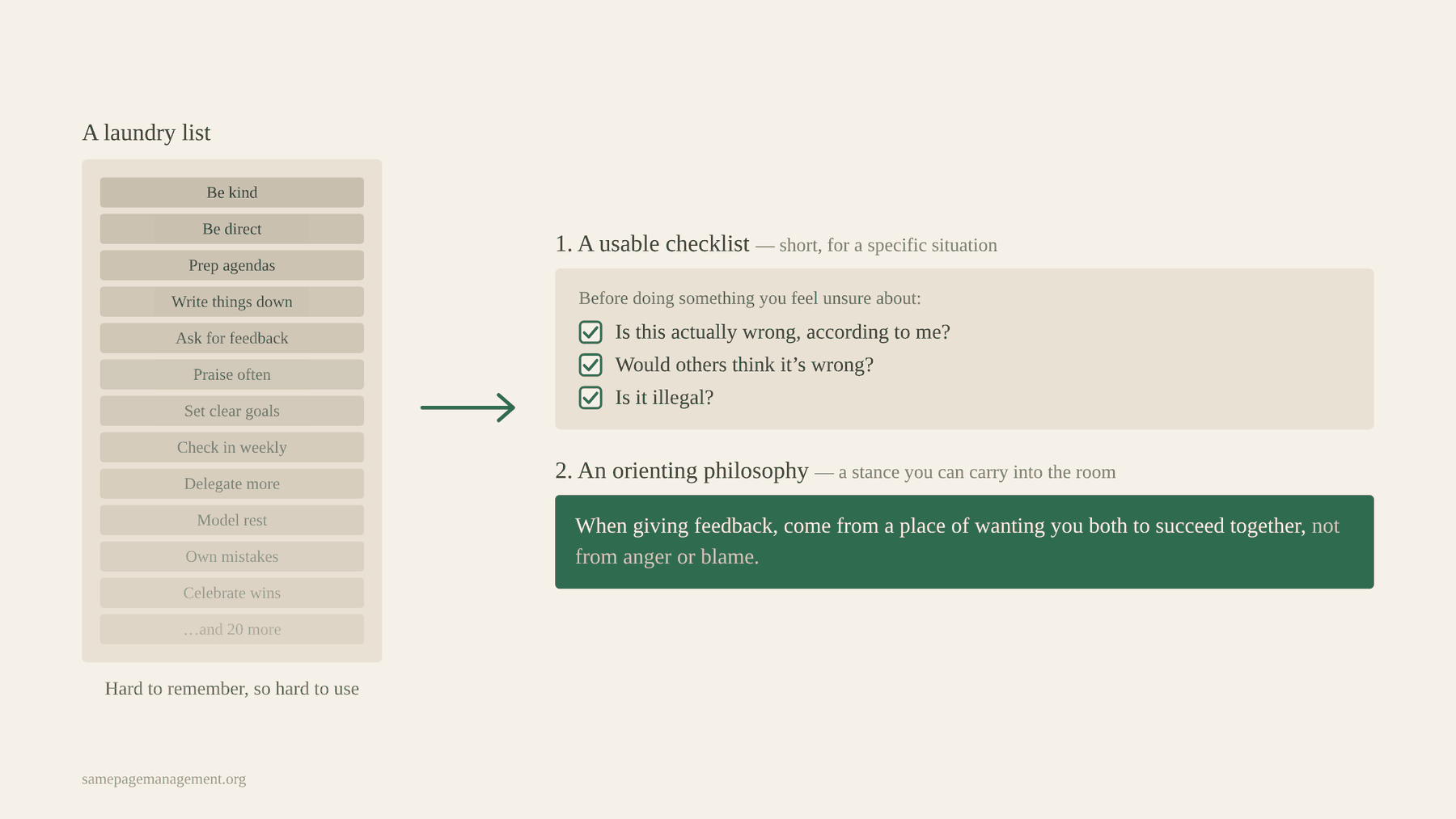
Instead, I find it easier to use either:
1. A usable checklist: Something that you can go and look at when you’re facing a particular situation.
The best checklists are short, with only the few most important items (so it’s not too onerous to check).
For instance, “Before doing something that you feel unsure about, ask yourself ‘Is this actually wrong according to me? Would others think that it’s wrong? Is it illegal?’”
OR
2. An orienting philosophy: A kind of approach or emotional tone or framing to the whole issue.
For instance, “When giving feedback, you should be coming from a place of trying to make sure that you and the other person succeed together in the future. Before you give feedback, check that that’s where you’re coming from (rather than from a place of e.g. anger or blame).”
I think that the second type of advice is particularly useful in social situations, where pulling out a checklist is not feasible.